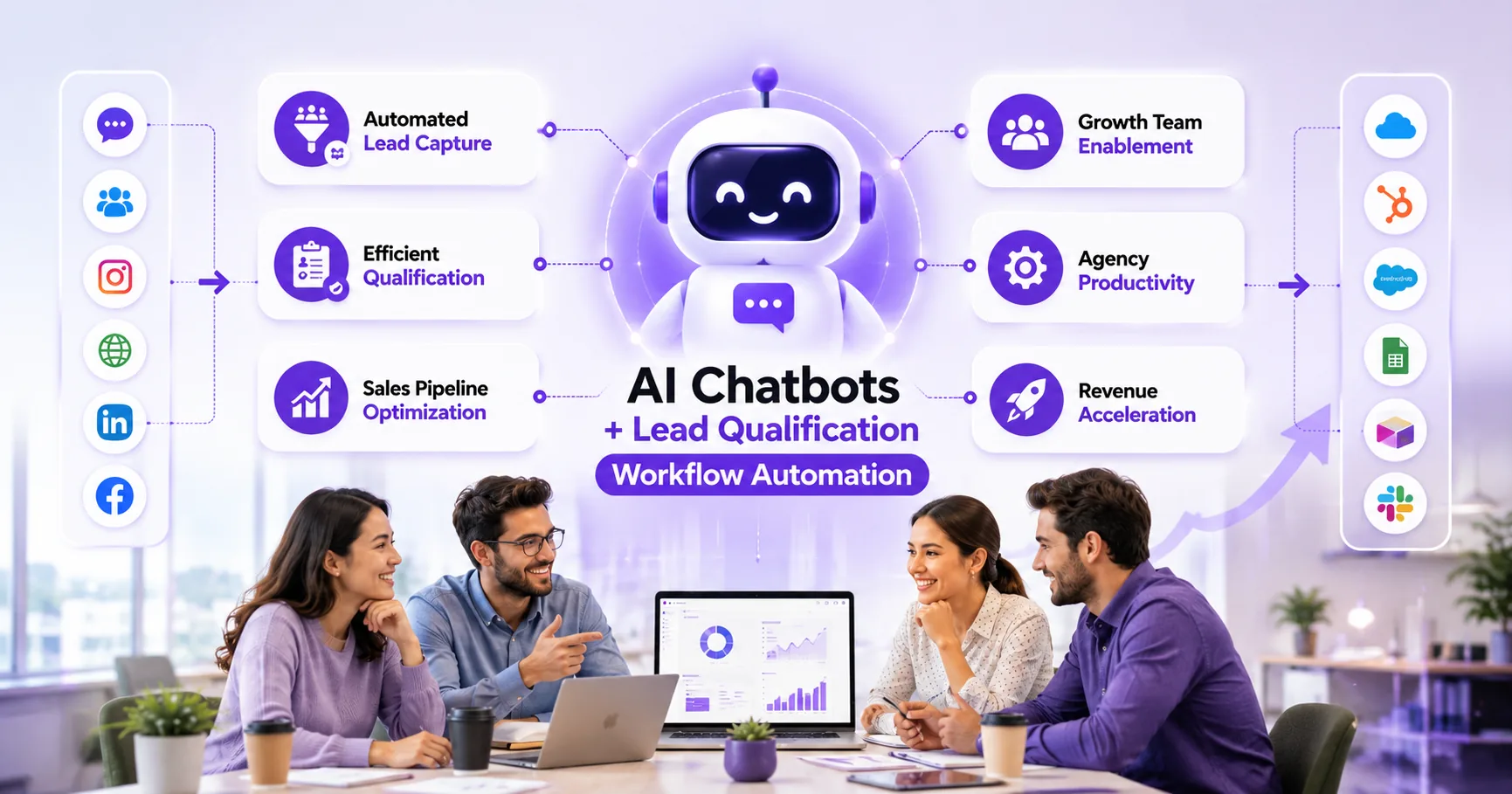
Learn how agencies and growth teams can implement AI chatbots integrated with lead qualification workflows to automate and optimize their sales pipelines in 2026. This article provides practical steps, key features, top tools, and real-world case studies to help you improve lead automation efficiency and conversion rates.
Why AI Chatbots and Lead Qualification Matter for Agencies and Growth Teams
If you run an agency or lead a growth team, you know the pain of chasing unqualified leads, slow follow-ups, and sales reps buried in repetitive questions. In 2026, AI chatbots lead qualification is no longer a futuristic idea—it's a must-have for agencies and growth teams that want to scale their pipeline, improve lead quality, and keep sales moving without burning out your team.
Clients expect instant answers and tailored engagement. Manual lead screening and scattered CRM notes just cannot keep up. Modern AI chatbots can ask qualifying questions, score leads, sync with your CRM, and trigger automated workflows—24/7, across chat, web, and messaging apps. According to Alta's 2026 AI agents guide, agencies using AI-powered lead qualification workflows are seeing faster response times and higher conversion rates by automating the early sales funnel. Leading platforms now offer no-code chatbot builders, CRM integration, and workflow automation designed for agency sales cycles (see 2026 conversational AI tools).
This article breaks down how agencies and growth teams can implement AI chatbots and lead qualification workflow automation—from tool selection to step-by-step build, with real-world patterns and tradeoffs. If you are weighing DIY automation versus hiring a partner, or want to see what works in practice, you are in the right place. For more on automating sales follow-up, check out our guide to lead follow-up automation. To see how Prompt Gurru can help you build or optimize your AI sales workflows, visit our AI automation services page.
Understanding Lead Qualification Workflow Automation with AI Chatbots
For agency owners and growth teams, the speed and accuracy of lead qualification can make or break your sales pipeline. Lead qualification workflow automation refers to using digital tools to automatically assess, score, and route inbound leads—without manual effort from your team. When you add AI chatbots to this process, you create a system that engages prospects 24/7, asks targeted questions, and triggers next steps based on real-time responses.
Here’s how a typical AI chatbots lead qualification workflow looks in 2026: a chatbot greets website visitors or responds to inbound messages, asks qualifying questions (like budget, timeline, or project needs), and uses their answers to score the lead. Based on those responses, the workflow can assign a sales rep, schedule a call, or send tailored follow-up content—without human intervention. This approach is now standard for high-performing agencies and growth teams, as it reduces response times and ensures no lead falls through the cracks.
According to Zendesk's 2026 overview, AI-powered chatbots use intent-based questions to prioritize high-value accounts and automate much of the early sales conversation. Many platforms now offer direct CRM integration, so qualified leads are synced instantly to your sales pipeline. For example, conversational AI tools can capture lead data, automate demo scheduling, and trigger workflow automation steps in real time.
The main business benefits for agencies and growth teams include:
- Faster lead response: AI chatbots engage every prospect instantly, even outside business hours.
- Consistent qualification: Automated workflows ensure every lead is asked the right questions, every time.
- Reduced manual workload: Sales teams spend less time on repetitive screening and more on closing deals.
- Improved conversion rates: High-intent leads are identified and routed to the right person or nurture sequence immediately.
For a deeper dive into automation platforms and how they fit into this process, see our guide to workflow automation software. When implemented well, AI chatbots and lead qualification workflow automation can transform your agency's sales efficiency and help you scale without adding headcount.
Key Features and Capabilities of AI Chatbots for Lead Qualification
Modern AI chatbots are transforming how agencies and growth teams qualify leads by automating conversations, capturing data, and integrating directly with sales workflows. To be effective in 2026, an AI chatbot for lead qualification should offer a blend of advanced language skills, smart routing, and seamless integration with your existing tech stack.
Natural Language Understanding (NLU) and Intent Detection: The core of any high-performing AI chatbot is its ability to understand and respond to real human language. This means recognizing buyer intent, qualifying questions, and even subtle cues that indicate sales readiness. According to Zendesk's 2026 sales chatbot guide, intent-based questions help teams prioritize high-value leads automatically, reducing manual triage.
Automated Lead Capture and Qualification: AI chatbots can ask qualifying questions, score leads in real time, and segment prospects based on their responses. This allows agencies to focus on leads most likely to convert, while ensuring no opportunity slips through the cracks. As highlighted in the respond.io roundup of AI agents, automated conversation workflows are now standard for routing and qualifying leads at scale.
CRM and Workflow Automation Integration: The best AI chatbots connect directly to your CRM (like HubSpot or Salesforce) and automation platforms (such as n8n or Zapier). This enables instant lead creation, updates, and follow-up tasks without manual data entry. For example, Consensus's 2026 tools review notes that CRM-connected chatbot workflows are now a must-have for agencies looking to streamline demo requests and nurture sequences.
Automated Routing and Escalation: When a lead meets certain criteria, the chatbot can trigger automated routing—assigning leads to the right sales rep, booking meetings, or escalating hot prospects for immediate follow-up. This reduces response times and ensures high-value leads never get stuck in the pipeline.
Omnichannel Support and Personalization: In 2026, agencies expect chatbots to work across web, mobile, and messaging platforms, delivering a consistent and personalized experience. AI chatbots can remember past interactions, tailor questions, and adapt scripts based on user behavior, increasing engagement and conversion rates.
For agencies and growth teams, these features are not just nice-to-haves—they are essential for building a scalable, data-driven lead qualification workflow. If you want to see how these capabilities fit into a real automation stack, check out our AI Automation Tools for Small Business 2026 guide or browse our portfolio case studies for practical examples.
Top Tools and Platforms for AI Chatbots and Workflow Automation in 2026
For agencies and growth teams automating lead qualification in 2026, the right platform can make or break your workflow. Here are six leading tools that agencies rely on for AI chatbot integration, workflow automation, and CRM connectivity—each suited to different needs and technical stacks.
- n8n: A flexible, open-source automation platform ideal for agencies that want to orchestrate custom lead qualification flows, connect chatbots to CRMs, and automate follow-ups. Self-hosted Community edition is free (hosting extra), with paid cloud plans available. See n8n pricing (as of July 2026).
- Zapier: Known for its no-code interface and vast app ecosystem, Zapier lets agencies quickly connect chatbots, forms, and CRMs. Its task-based billing model and ready-made templates are a fit for teams without in-house developers. See Zapier pricing (as of July 2026).
- Make: Popular for its visual scenario builder and granular logic, Make is a go-to for agencies needing complex lead routing and enrichment. Plans are credit/operation-based. See official Make pricing.
- HubSpot: A leading CRM and marketing suite, HubSpot offers built-in AI chatbots, lead scoring, and workflow automation. Agencies seeking an all-in-one platform for sales, marketing, and service often choose HubSpot. See official HubSpot pricing.
- Microsoft Power Automate: For teams working in the Microsoft 365 ecosystem, Power Automate delivers robust workflow automation, chatbot integration, and process mining. Per-user and per-flow plans are available. See Power Automate pricing (as of July 2026).
- Zendesk AI Chatbots: Zendesk’s AI-powered chatbots are designed for sales and support teams, with strong lead qualification and CRM integration features. Agencies can automate lead capture and prioritize high-value accounts. Learn more about Zendesk AI chatbots.
For a deeper look at how agencies are combining chatbots and workflow automation, see the Top 9 Conversational AI Tools for Demo Generation (2026) and Best AI Agents for B2C Lead Generation 2026. These resources detail CRM-connected chatbot workflows and real-world automation patterns.
Each platform brings unique strengths—whether you need open-source flexibility, no-code speed, or deep CRM integration. For a breakdown of chatbot build costs and what to expect in 2026, check out our article How Much Does a Chatbot Cost in 2026? A Simple Breakdown. If you need help choosing or implementing the right stack, our AI automation services can guide you from strategy to launch.
Step-by-Step Guide to Building an AI Chatbot Lead Qualification Workflow
Building an AI chatbot lead qualification workflow in 2026 is about connecting the right automation tools, chat interfaces, and CRM systems so your agency or growth team can capture, qualify, and route leads with minimal manual effort. Here’s how to approach it from design to deployment:
- Map Your Lead Journey and Qualification Criteria
Start by defining what makes a lead qualified for your agency. List the questions your sales team asks, the data you need (budget, timeline, service need), and the triggers for routing or follow-up. This blueprint will drive your chatbot’s script and automation logic. - Choose Your AI Chatbot Platform
Pick a chatbot builder that supports natural language processing, branching logic, and easy integration with your CRM. Many agencies use platforms like Intercom, Drift, or custom OpenAI-powered bots. For a technical stack, n8n or Zapier can orchestrate workflows between your chatbot and backend systems. See this overview of conversational AI tools for current options. - Design Conversational Flows and Qualification Logic
Draft your chatbot’s conversation tree. Use intent-based questions to segment leads and collect key info. For example, ask about project scope, budget, and urgency. According to Zendesk’s 2026 guide, high-performing chatbots use dynamic, context-aware questions to prioritize high-value leads. - Integrate with Your CRM and Automation Tools
Connect your chatbot to your CRM (like HubSpot or Salesforce) so qualified leads are instantly logged and routed. Use workflow automation tools such as n8n, Zapier, or Microsoft Power Automate to trigger notifications, assign owners, and schedule follow-ups. This step ensures no lead falls through the cracks and your team can act fast. - Test, Launch, and Monitor
Before going live, test your chatbot with real users and edge cases. Monitor conversations for drop-offs or misclassifications, and refine your scripts and logic. Agencies often iterate weekly in the first month to optimize conversion and qualification rates. For more on auditing and improving your workflow, see our workflow audit guide.
For a deeper dive into website chatbot implementation, check our AI chatbot for lead qualification on your website article. If you want a custom workflow mapped to your stack, book a discovery call with Prompt Gurru.
Case Study: AI Chatbot Lead Qualification Patterns from Prompt Gurru’s Agency Growth Projects
For agencies and growth teams, the difference between a busy pipeline and a stagnant one often comes down to how efficiently you qualify and route leads. Over the past two years, Prompt Gurru has delivered AI chatbot lead qualification workflows for agency-focused platforms like Zeebrix and our own Facebook Ad Optimizer (illustrative example). Here’s how we approached these projects, what worked, and what agency leaders should know before building or buying their own solution.
Workflow Design and Stack
Both Zeebrix and Facebook Ad Optimizer needed to capture inbound leads from multiple channels—website chat, landing pages, and paid ad forms. We implemented AI-powered chatbots that asked qualification questions (budget, timeline, service interest) and scored leads in real time. The stack combined a conversational AI layer (using OpenAI API for natural language understanding), a workflow engine for branching logic, and CRM integration for automated handoff to sales.
In the Zeebrix pattern, the chatbot greeted visitors, identified their intent, and used a dynamic question flow to segment leads by project size and urgency. Qualified leads were pushed directly into the agency’s CRM with tags for follow-up, while lower-fit leads received automated nurture sequences. For Facebook Ad Optimizer, the chatbot was embedded on campaign landing pages, qualifying leads before syncing them to the client’s pipeline and triggering Slack alerts for hot prospects.
Outcomes and Lessons Learned
Agencies using these workflows reported faster response times and higher conversion rates from chatbot-qualified leads. The AI chatbots filtered out low-fit inquiries, saving sales teams hours each week and letting them focus on high-value prospects. According to industry guides like Alta’s 2026 AI sales agent guide, this pattern—AI-driven qualification, automated routing, and CRM sync—is now standard for high-performing growth teams.
One key lesson: success depends on tight integration between the chatbot, workflow automation, and CRM. Agencies that tried to bolt on generic chat widgets without workflow logic saw little improvement. The best results came from customizing the chatbot’s questions and scoring rules to match the agency’s unique sales process.
For more examples of shipped agency automation, see our Portfolio case studies or explore the Facebook Ad Optimizer product page.
DIY vs Hiring a Custom AI Automation Partner: What Agencies Should Consider
For agencies and growth teams looking to automate lead qualification with AI chatbots, the decision to build in-house or hire a specialist like Prompt Gurru is a pivotal one. Each path has distinct tradeoffs in cost, expertise, time-to-value, and long-term scalability.
DIY Approach: Building your own AI chatbot workflow can seem appealing if you have a tech-savvy team and want full control. Many agencies start by experimenting with no-code tools or off-the-shelf chatbot builders. This route can work for straightforward use cases, especially if you have internal resources familiar with platforms like n8n or Zapier. However, as workflows become more complex—think multi-branch qualification logic, CRM integrations, or custom scoring—internal projects often stall or balloon in scope. According to industry guides, teams underestimate the time required for robust testing, ongoing maintenance, and adapting to new sales processes. DIY builds also risk knowledge silos if the original implementer leaves.
Hiring a Specialist: Partnering with an automation studio like Prompt Gurru brings deep experience in shipping AI chatbot and workflow solutions for agencies. You get access to proven frameworks, custom integrations, and best practices that accelerate deployment and reduce risk. For example, our team has delivered agency-focused automation using both no-code and custom-coded stacks, ensuring your lead qualification process fits your unique pipeline—not just a generic template. This approach is especially valuable if you need advanced features, multi-system sync, or want to future-proof your stack for scale. As highlighted in recent overviews, expert-led builds are better positioned to handle intent-based qualification, CRM handoff, and compliance from day one.
Cost and Time Considerations: DIY projects may seem cheaper upfront but often require significant staff time and hidden costs for troubleshooting, platform limits, and missed leads during rollout. Hiring a partner involves a scoped investment but typically delivers faster ROI and ongoing support. If you want to see how custom automation could work for your agency, contact Prompt Gurru or book a free discovery call to discuss your specific workflow and goals.
For more on automation tool selection and workflow design, see our articles How to build an AI chatbot for lead qualification on your website and Workflow Automation Software: How It Works and What to Buy in 2026.
Pricing Overview and SaaS Options for AI Chatbot and Workflow Automation Tools
Budgeting for AI chatbots and lead qualification workflow automation in 2026 means weighing both SaaS subscription costs and operational needs. Agencies and growth teams have a wide range of options, from flexible workflow builders to all-in-one CRM platforms. Below is a concise breakdown of the leading tools and their pricing models, with links to official pricing pages for up-to-date details.
- n8n: n8n offers a free self-hosted Community edition (you cover hosting), plus paid cloud plans. Pricing is per workflow execution and user, with details at n8n.io/pricing (as of July 2026).
- Zapier: Zapier uses a task-based billing model. Free plans allow basic automation, while Professional and Team tiers unlock advanced features and higher task volumes. See Zapier pricing for current tiers and limits (as of July 2026).
- Make: Make (formerly Integromat) uses credit/operation-based plans, with Core, Pro, and Teams tiers. For exact details, see official Make pricing.
- HubSpot: HubSpot's pricing is tiered by hub and feature set. Professional and Enterprise plans include advanced chatbot, workflow, and CRM automation, but require onboarding fees. For specifics, see official HubSpot pricing.
- Microsoft Power Automate: Power Automate offers per-user and per-flow plans, with cloud automation starting at $15/user/month (as of July 2026). Deep integration with Microsoft 365 is a key value driver. See Power Automate pricing for details.
For a broader look at conversational AI tools, industry guides like this 2026 comparison and Zendesk's AI chatbot overview highlight the growing role of CRM-connected chatbot workflows and automation for lead capture and qualification.
Total cost of ownership (TCO)
When budgeting, factor in not just SaaS subscription fees but also:
- API usage (especially for AI models or high-volume workflows)
- Hosting (for self-hosted tools like n8n Community)
- Maintenance and support (in-house or via a partner)
- Scope of revisions and team training
If you are considering a custom build or advanced integration, US agency rates typically range from $100 to $200/hr for boutique studios and $150 to $250/hr for specialist automation partners. This covers discovery, workflow design, build, testing, and training. For a detailed breakdown, see our chatbot cost guide or AI automation services.
Common Pitfalls and Best Practices in AI Chatbot Lead Qualification Automation
Even with the promise of AI chatbots and lead qualification workflow automation, agencies and growth teams often run into preventable mistakes that can stall results or frustrate prospects. Here are the most common pitfalls and how to avoid them, based on patterns we've seen across agency automation projects and industry best practices.
- Poor Data Quality and CRM Sync: If your chatbot relies on outdated or incomplete CRM data, it will ask irrelevant questions or misroute leads. Always ensure your chatbot is tightly integrated with your CRM and that data hygiene is a priority. Regular audits and automated syncs help keep records accurate. For practical steps, see How to Conduct a Workflow Audit to Identify Automation Opportunities for SMBs.
- Overcomplicated Conversation Flows: Many teams try to make their AI chatbots too clever, resulting in long or confusing conversations. According to Zendesk's 2026 guide, intent-based questions that prioritize high-value accounts work best. Keep flows concise, focused on qualifying criteria, and always offer a human handoff option.
- Lack of Personalization: Generic chatbot scripts miss the mark for agencies with niche clients. Use dynamic fields and context from previous interactions to tailor questions and responses. As highlighted in Alta's 2026 AI sales agent guide, personalized outreach increases conversion rates and builds trust.
- Ignoring User Experience (UX): If your chatbot is slow, buggy, or hard to use on mobile, leads will drop off. Test across devices and browsers, and monitor drop-off points. Prioritize clear language and quick response times.
- Insufficient Integration with Sales Workflows: Automating lead qualification is only valuable if qualified leads are routed instantly to the right sales rep or workflow. Ensure your automation platform (like n8n or Zapier) is set up to trigger follow-ups, notifications, and CRM updates in real time. For more on workflow automation tools, see this industry roundup.
Pro tip: Schedule quarterly reviews of your chatbot's performance and lead flow with both sales and marketing teams. This helps catch issues early and keeps your automation aligned with evolving business goals.
Frequently Asked Questions About AI Chatbots and Lead Qualification
How much do AI chatbots for lead qualification cost?
Costs vary based on platform, features, and integration needs. SaaS chatbot and workflow automation tools like n8n, Zapier, and Make offer subscription plans, often starting with free or entry-level tiers and scaling up for advanced features. For example, n8n offers a free self-hosted option (hosting extra), while Zapier and Make use task- or credit-based billing (Zapier pricing, Make pricing). Custom-built solutions can range from $8,000 to $25,000+ (illustrative US agency bands) depending on complexity, integrations, and training. For a full breakdown, see How Much Does a Chatbot Cost in 2026?.
What is the typical timeline to implement lead qualification automation?
Most agencies can launch a basic AI chatbot lead qualification workflow in 2 to 6 weeks using off-the-shelf tools. Custom integrations or advanced branching logic may extend timelines to 6 to 12 weeks. The process includes requirements gathering, bot design, workflow setup, CRM integration, testing, and team training. For a step-by-step approach, review this practical AI agent implementation guide.
Which AI chatbot tools are best for agencies in 2026?
Top-rated options for agencies include Intercom, Drift, and Zendesk for conversational AI with strong CRM integration (Zendesk AI chatbot for sales). For workflow automation, n8n, Zapier, and Make remain popular for their flexibility and integration libraries. For a curated list, see Top 9 Conversational AI Tools for Demo Generation (2026) and Best AI Agents for B2C Lead Generation 2026.
Can AI chatbots integrate with existing CRMs?
Yes, most leading AI chatbots and workflow tools offer native or API-based integrations with popular CRMs like HubSpot, Salesforce, and Zoho. This allows chatbots to capture, score, and route leads directly into your sales pipeline. When evaluating tools, confirm CRM compatibility and test the integration before rollout. For more on CRM-connected workflows, see Best CRM for Small Business in 2026 - Slack and this comparison.
Should agencies build AI chatbots in-house or hire a partner?
Building in-house gives you control but requires technical expertise, ongoing maintenance, and time investment. Hiring a specialist partner like Prompt Gurru accelerates delivery, reduces risk, and ensures best practices for workflow automation and CRM integration. Agencies with complex needs or limited dev resources often benefit from partnering. For a detailed tradeoff analysis, see When to Hire a Custom Software Developer vs Buying SaaS Tools or contact us for a discovery call.
About the author
Prompt Gurru Team is a specialist studio in AI automation, custom software, and digital product builds for agencies, growth teams, and startups. With over 10 years of experience, our team has delivered 50+ projects across mobile SaaS, marketplaces, HRM, education, and agency growth tooling.
Our portfolio includes shipped solutions like Zeebrix (agency growth), Facebook Ad Optimizer, and Prompt Gurru Blogs (AI content automation). We specialize in n8n workflow automation, OpenAI integrations, and building lead qualification chatbots tailored to agency and growth team needs.
See more portfolio case studies or contact us for a tailored consultation. Ready to discuss your project? Book a free discovery call.
Ready to automate your business?
We build n8n workflows, AI pipelines, Flutter apps, and custom software for startups and SMEs - like the system that powers this blog.
Book a free discovery call