Choosing the right CRM is critical for small businesses aiming to streamline sales and customer management. This guide compares top CRM options in 2026 with a focus on Slack's role and integration potential to help SMB owners make informed decisions.
Picking the best CRM for small business in 2026 is not just about features or price, it's about how well your CRM fits into your team's daily workflow. For many SMBs, Slack has become the digital headquarters for communication, so the ability to connect your CRM directly to Slack can make or break adoption. In this guide, we'll compare the top CRM options for small businesses, break down pricing and integration details, and show how Slack can become the nerve center for sales, support, and automation. If you're an owner or ops lead looking to streamline customer management and boost productivity, you'll find actionable advice, tool comparisons, and a clear path to implementation here. This guide also covers best CRM for small business 2026, Slack CRM integration, and small business CRM comparison.
Why Choosing the Right CRM Matters for Small Businesses in 2026
For small businesses, a CRM is more than just a database, it's the backbone of sales, support, and customer relationships. The right CRM helps you track leads, centralize customer data, and automate repetitive tasks. In 2026, the stakes are higher: customers expect fast, personalized responses, and teams are often distributed or hybrid. A CRM that integrates with your communication tools, especially Slack, can bridge gaps between sales, support, and operations.
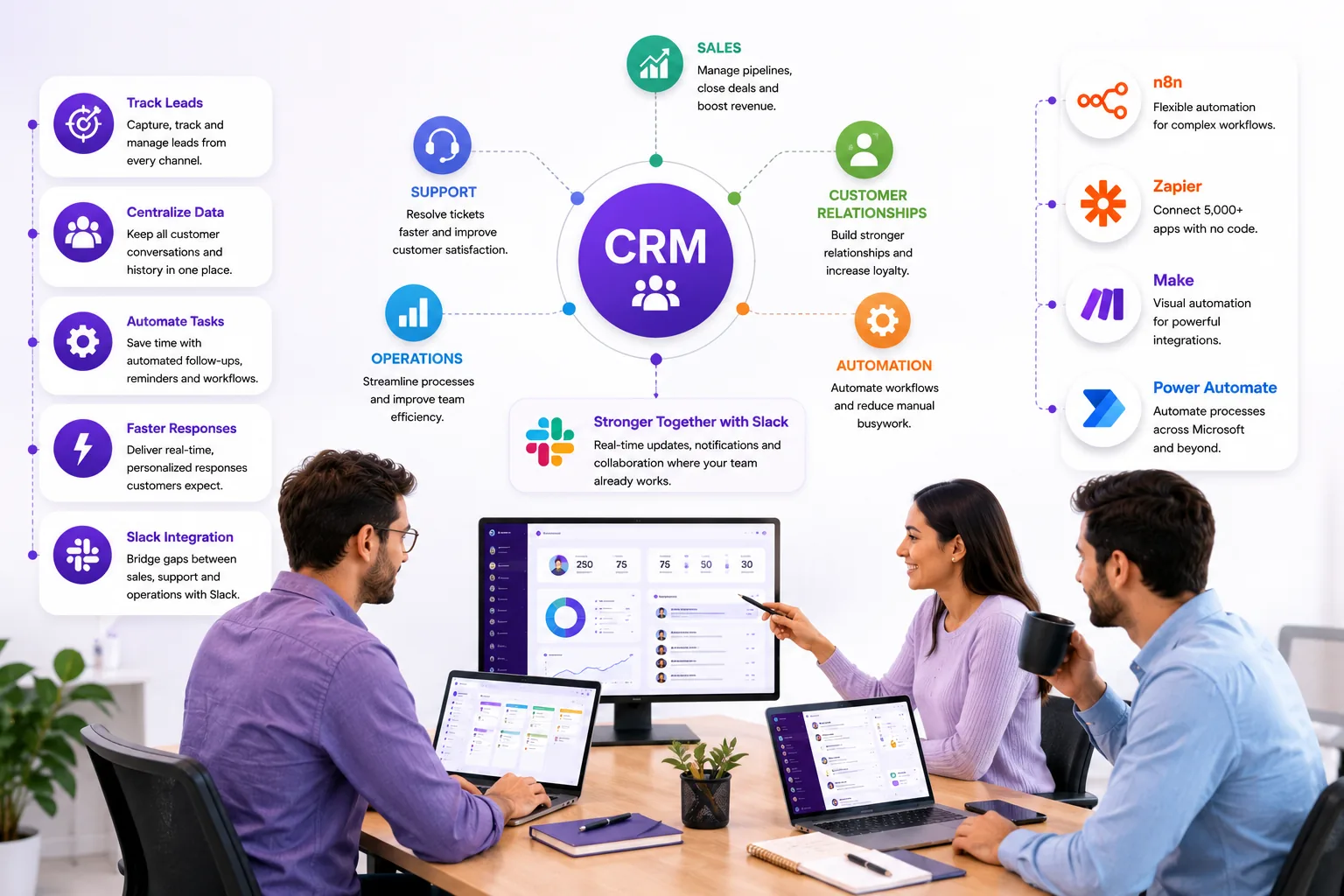
- Platform choice: n8n, Zapier, Make, HubSpot, or Power Automate bill differently.
- Workflow complexity: Branching logic and integrations drive build hours.
- Task or operation volume: SaaS plans charge per run; model expected monthly volume.
- Custom UI or apps: Portals and mobile clients add scope beyond orchestration alone.
- Support and maintenance: Budget for hosting, API usage, and an annual retainer.
Slack's rise as the go-to communication platform for SMBs means that your CRM should work where your team already spends time. Whether it's getting instant lead notifications, assigning tasks, or syncing customer conversations, a Slack-integrated CRM can boost collaboration and reduce context-switching. We've seen in our client projects that teams who connect their CRM to Slack respond faster, close more deals, and have better visibility into customer issues.
Common Mistakes Small Businesses Make When Selecting a CRM
Choosing a CRM is a big decision, and many small businesses fall into predictable traps. Here are three mistakes we've seen firsthand:

- Ignoring Slack integration or workflow fit: Some teams pick a CRM based on features or price, only to discover later that it doesn't connect smoothly to Slack or disrupts their daily routines. This leads to poor adoption and wasted investment.
- Underestimating total cost of ownership: It's easy to focus on monthly subscription fees, but onboarding, training, and ongoing maintenance can add up. Many CRMs require mandatory onboarding fees (like HubSpot), and custom integrations may need a maintenance retainer.
- Overlooking scalability and automation: Small businesses often choose a CRM that's 'good enough' for now, but outgrow it within a year. If your CRM can't automate key workflows or scale with your team, you'll face costly migrations down the road.
Practitioner tip: Always map out your team's daily workflow and Slack usage before picking a CRM. If your sales or support team lives in Slack, prioritize CRMs with native or easy-to-build Slack integrations. This avoids painful change management later.
Comparison of Top CRMs for Small Business in 2026 with Slack Integration
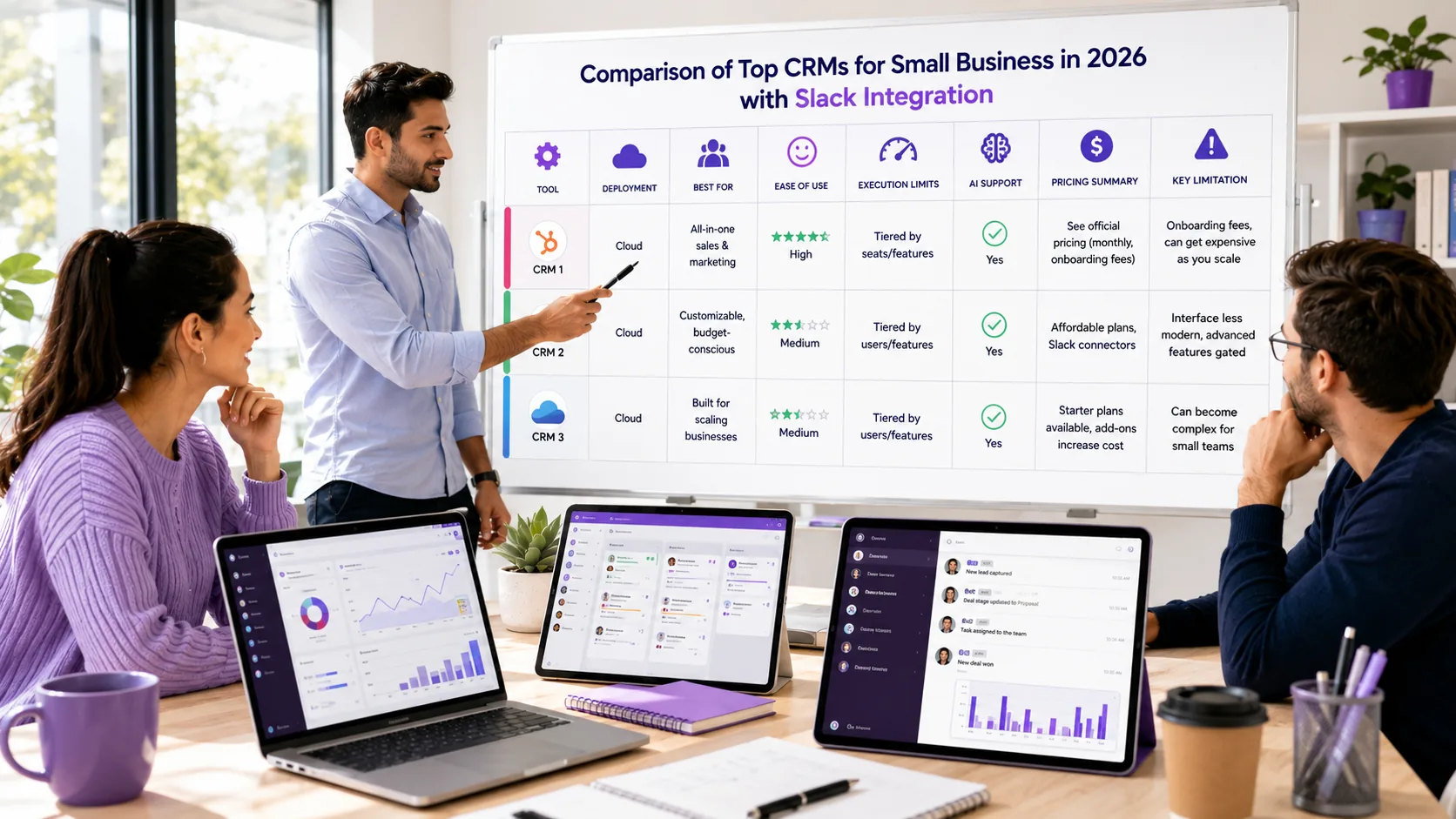
Not all CRMs are created equal when it comes to Slack integration, automation, and SMB-friendly pricing. Here's how the top contenders stack up for small businesses in 2026:
| Tool | Deployment | Best for | Ease of use | Execution limits | AI support | Pricing summary | Key limitation |
|---|---|---|---|---|---|---|---|
| HubSpot CRM | Cloud | All-in-one sales & marketing | High | Tiered by seats/features | Yes | Official HubSpot pricing (monthly, onboarding fees) | Onboarding fees, can get expensive as you scale |
| Zoho CRM | Cloud | Customizable, budget-conscious | Medium | Tiered by users/features | Yes | Zoho CRM pricing, Slack connectors included in higher tiers | Interface less modern, advanced features gated |
| Salesforce Essentials | Cloud | Scalable, advanced automation | Medium-Low | Tiered by users/features | Yes | Salesforce Essentials pricing, Slack via app marketplace | Steep learning curve for SMBs |
| Pipedrive | Cloud | Sales-focused, easy onboarding | High | Tiered by features | Limited | Pipedrive pricing, SMB-friendly pricing, Slack notifications | Less marketing automation |
| Slack as CRM Hub (with n8n/Zapier) | Cloud/self-hosted | Teams living in Slack, custom workflows | Varies (depends on setup) | Depends on automation tier | Yes (via OpenAI, n8n, Zapier) | n8n pricing, Zapier pricing | Requires setup, not plug-and-play |
HubSpot CRM remains a favorite for SMBs due to its all-in-one features and strong Slack integration. Zoho CRM is a budget-friendly alternative with good customization and Slack connectors. Salesforce Essentials brings powerful automation, but the learning curve and cost can be high for smaller teams. Pipedrive is popular for its user-friendly sales pipeline and Slack notifications, though it lacks deep marketing automation. For teams that want Slack as their primary hub, combining Slack with n8n or Zapier allows for custom CRM workflows, but setup requires technical know-how.
Pricing Overview and Total Cost of Ownership for Small Business CRMs
CRM pricing can be confusing, especially when you add Slack integration and automation into the mix. Here's a breakdown of what to expect in 2026, with links to official vendor pricing for transparency:
- HubSpot CRM: Pricing is tiered by features and user seats, with mandatory onboarding fees for Professional and above. For current details, see official HubSpot pricing. Budget for onboarding and potential add-ons.
- Zoho CRM: Offers affordable monthly plans with Slack connectors included in higher tiers. No mandatory onboarding, but advanced automation may require technical setup. See Zoho CRM pricing for details.
- Salesforce Essentials: Entry-level pricing is higher, and advanced Slack integration may require third-party apps or custom development. Visit Salesforce Essentials pricing for current plans.
- Pipedrive: SMB-friendly monthly pricing, with Slack notifications available on most paid plans. No onboarding fees, but limited marketing automation. Pricing details at Pipedrive pricing.
- Slack + n8n/Zapier: For automation, n8n offers a free self-hosted Community edition (hosting extra), while Zapier uses task-based billing (free for up to 100 tasks/month as of June 2026). Paid plans start at /month for 750 tasks, with higher tiers for more tasks and features. For Make, see official Make pricing (credit/operation-based plans) see official Make pricing
For custom integrations, such as building a Slack-CRM workflow with n8n or Zapier, illustrative US agency build costs range from $15,000 to $40,000 depending on complexity. This typically includes discovery, workflow build, testing, documentation, and team training. Ongoing maintenance retainers (for updates, bug fixes, and minor revisions) are usually billed separately, often $200 to $500/month for SMBs. Always clarify what's included in your scope.
Total cost of ownership
When budgeting, consider:
- Subscription fees (per user, per month)
- Mandatory onboarding (HubSpot, Salesforce)
- Custom integration build (if using n8n, Zapier, or Make)
- Hosting costs for self-hosted tools (n8n Community edition)
- Ongoing maintenance and revision scope
Note: Prices are indicative as of June 2026 and vary by vendor, region, and contract terms. Always verify the latest pricing and terms directly on vendor websites: HubSpot, Zapier, n8n, Microsoft Power Automate, Make, Zoho CRM, Salesforce Essentials, and Pipedrive.
Illustrative Case Study: Streamlining Sales and Support with Slack and HubSpot CRM (illustrative example)
Before
Illustrative example: A small e-commerce business with 8 staff spent 15 to 20 hours every week on manual follow-up, status updates, and data entry. Sales and support teams used separate tools, email, spreadsheets, and a basic ticketing system, which led to communication delays and missed opportunities.
Solution
The business implemented HubSpot CRM with native Slack integration. Using Zapier, they set up workflows to send real-time notifications to Slack channels when new leads arrived or support tickets were updated. Lead assignment and follow-up reminders were automated, and a custom n8n workflow synced customer support tickets from Slack directly into HubSpot CRM for unified tracking.
Results
After rollout, the sales team saved 10 to 15 hours weekly on manual tasks. Response times improved, and customer satisfaction scores went up. With Slack as the central hub, both sales and support had better visibility into each other's activities, reducing miscommunication and speeding up resolutions.
Roadmap for Implementing a Slack-Integrated CRM in Your Small Business
Rolling out a Slack-integrated CRM is not a one-click affair. Here's a practical roadmap we use with our clients:
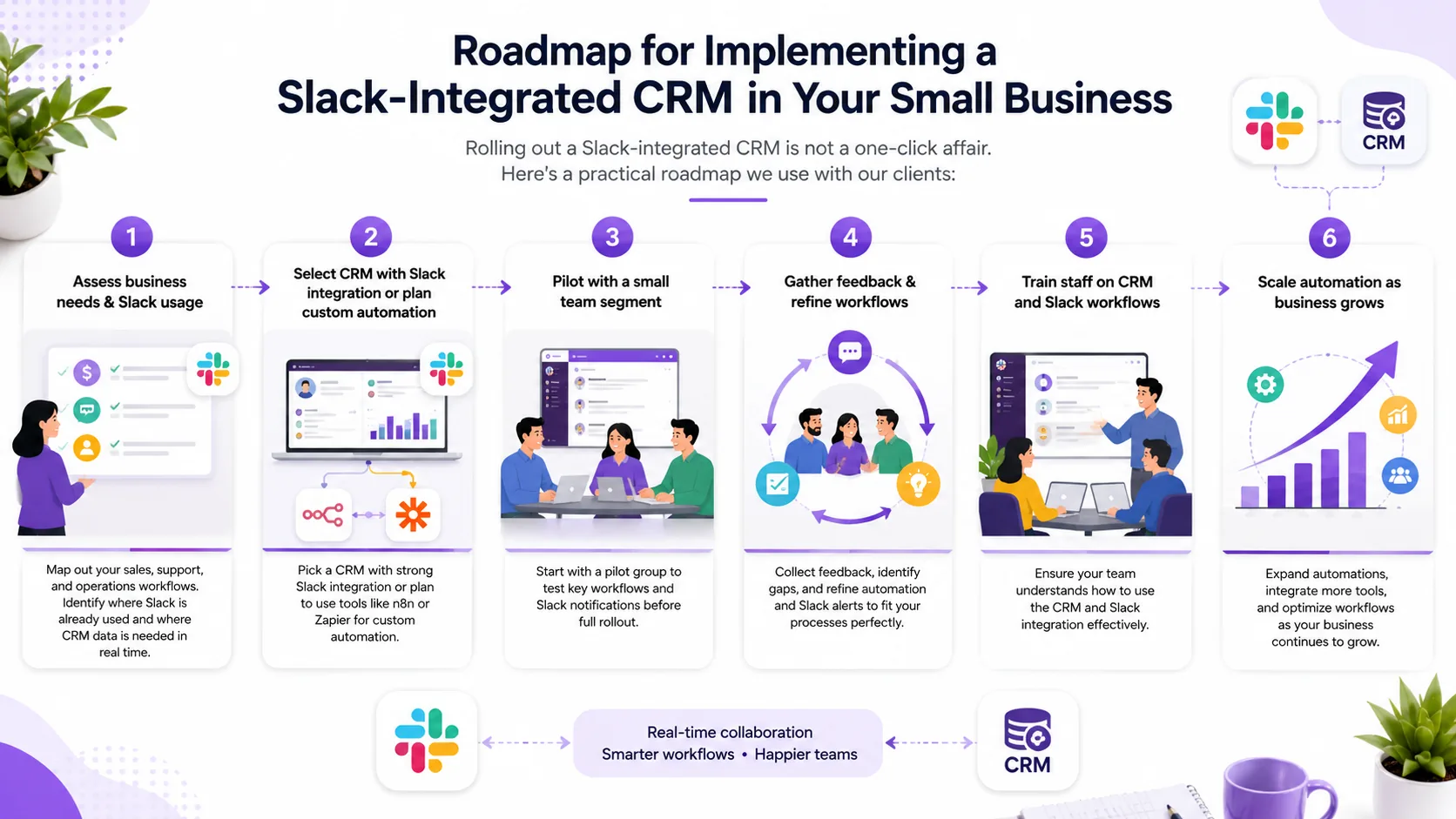
- Assess needs: Map out your sales, support, and operations workflows. Identify where Slack is already used and where CRM data is needed in real time. Common pitfalls include overlooking key user roles or missing integration points. For example, ensure you include sales reps, customer support, and marketing teams in the assessment to capture all relevant workflows.
- Choose your stack: Pick a CRM with strong Slack integration (like HubSpot or Pipedrive), or plan to use n8n or Zapier for custom workflows if your needs are unique. Evaluate vendor support and community resources. Consider trial periods to test integration capabilities and ease of use.
- Pilot and iterate: Start with a small team or department. Gather feedback through surveys or interviews, adjust automations, and document best practices. Use this phase to identify bottlenecks and user adoption challenges. For instance, if notifications are overwhelming, refine filters or channels.
- Train and support: Provide hands-on training and clear documentation. Make sure staff know how to use Slack notifications and CRM features together. Consider creating quick reference guides or video tutorials. Schedule follow-up sessions to address questions and gather ongoing feedback. Encourage a feedback loop to continuously improve user experience and address any challenges promptly.
- Scale up: Once workflows are stable, roll out to the rest of the team. Review and refine automations quarterly as your business grows. Plan for periodic audits to ensure integrations remain aligned with business goals. Monitor key metrics like response times and user engagement to guide improvements.
- Maintain and evolve: Continuously monitor integration performance and user satisfaction. Stay updated on new CRM and Slack features that can enhance your workflows. Allocate resources for ongoing maintenance and iterative improvements to keep your system efficient and aligned with evolving business needs.
Frequently Asked Questions About CRMs and Slack Integration for SMBs
- Can Slack replace a traditional CRM for small businesses?
Slack is a powerful communication tool but not a full-featured CRM. With automation platforms like n8n or Zapier, you can build custom workflows that bring CRM data into Slack or use Slack as a lightweight CRM hub for simple use cases. For most SMBs, a dedicated CRM with Slack integration offers the best balance of features and communication. - What are the best automation tools to connect Slack with popular CRMs?
Top choices include:- n8n (self-hosted, open source)
- Zapier (no-code, cloud)
- Microsoft Power Automate (especially for Microsoft 365 users)
- How to manage CRM data privacy and compliance when integrating with Slack?
Best practices include:- Check CRM and Slack settings for data retention and access controls
- Limit sensitive notifications to private channels
- Use audit logs to track data flows
- Document data handling procedures for custom automations
- Regularly review compliance requirements
- What are typical onboarding times and costs for SMB CRM implementations?
Onboarding varies:- Simple setups: a few days
- Complex integrations: several weeks
- Paid onboarding often required for advanced HubSpot and Salesforce tiers
- Custom workflows require budgeting for discovery, build, testing, and training
- How to measure CRM ROI with Slack integration?
Track metrics such as:- Response time improvements
- Lead conversion rates
- Hours saved on manual tasks
- Qualitative benefits like faster sales cycles, fewer missed follow-ups, and better team morale
Practitioner Insights: Best Practices for CRM and Slack Integration
In our client projects, we've built everything from simple Slack lead alerts to full-blown CRM syncs using n8n and OpenAI. Here are some best practices we've learned:
- Use n8n for flexible, self-hosted automation: n8n lets you build custom workflows connecting Slack, HubSpot, Pipedrive, and more. It's free to self-host (see n8n pricing), but you'll need to budget for hosting and updates.
- Keep Slack notifications actionable: Too many alerts can cause fatigue. Only send high-priority CRM events (like new leads or urgent support tickets) to Slack channels.
- Review and adapt workflows: As your business grows, revisit your automations quarterly. We've seen teams outgrow their initial workflows within a year.
- Document and train: Good documentation and regular training are key to CRM adoption. Record short Loom videos or create a Notion playbook for your team.
- Hybrid approaches work: Some SMBs use an off-the-shelf CRM for core data, but rely on custom Slack workflows for notifications, reminders, or AI-powered lead scoring. This gives you flexibility without sacrificing structure.
We often wire up n8n Webhook nodes to catch CRM events, then use Slack nodes to post updates, and OpenAI nodes to summarize or categorize messages. This keeps teams informed without overwhelming them with noise.
also, ensure data privacy and compliance by limiting sensitive information in Slack notifications and implementing proper access controls. Regularly audit your integrations to identify and resolve any security risks. Finally, engage end-users early in the integration process to gather feedback and foster adoption, making adjustments as necessary to improve usability and value.
By following these best practices, small businesses can maximize the benefits of CRM and Slack integration, improving team collaboration, data accuracy, and customer engagement. Continuous evaluation and adaptation are key to sustaining long-term success.
About the author
Prompt Gurru Team is an AI automation and custom software studio with 10+ years experience. We specialize in CRM integrations, n8n workflow automation, and Slack customizations for startups and SMEs worldwide. Our shipped work includes Max Invoice, Max HR, Mindway, holo, and Wahy Institute, live on Google Play, the App Store, and the web. Trusted by founders at Max ERP, Mindway, Zeebrix, and Wahy Institute. Custom build ranges in our articles are illustrative US market estimates for scoped n8n/OpenAI/CRM work; request a discovery call for a quote on your stack. For more, visit Prompt Gurru.
Additional Resources
Ready to automate your business?
We build n8n workflows, AI pipelines, Flutter apps, and custom software for startups and SMEs - like the system that powers this blog.
Book a free discovery call