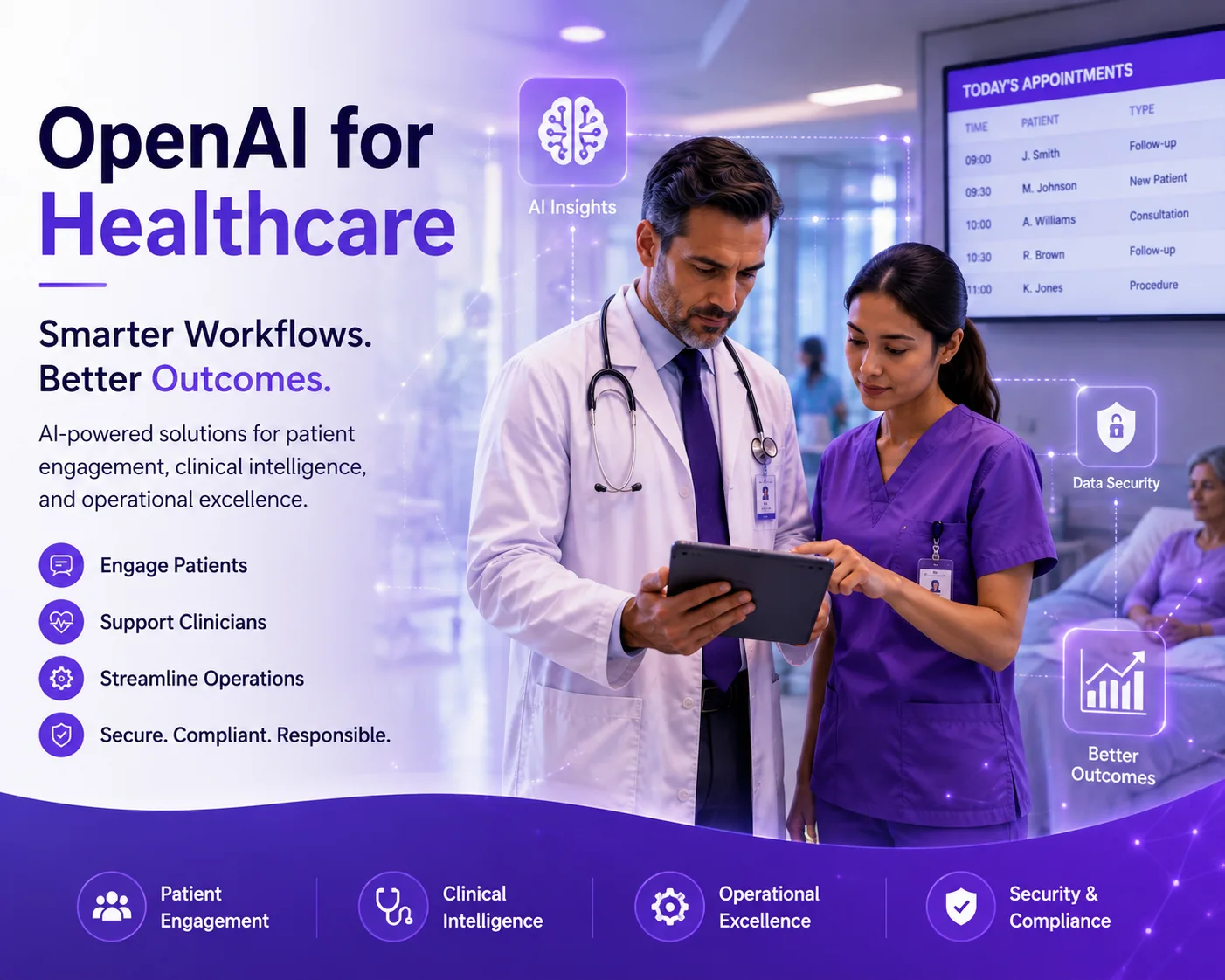
Learn how OpenAI is revolutionizing healthcare with AI-powered tools that enhance patient care, streamline clinical workflows, and improve operational efficiency. This article explores practical applications, best practices, and real-world examples to help healthcare leaders integrate AI effectively.
Why OpenAI Matters in Healthcare Today
Healthcare technology leaders are under pressure to deliver better patient outcomes, reduce staff burnout, and keep up with rising operational demands. OpenAI for Healthcare is more than a buzzword—it's a practical toolkit that is already reshaping how hospitals, clinics, and wellness platforms operate. Whether you're a digital health product owner or a clinical operations lead, the promise of AI in healthcare is now real: smarter patient engagement, faster clinical documentation, and streamlined workflows that actually fit the needs of care teams.
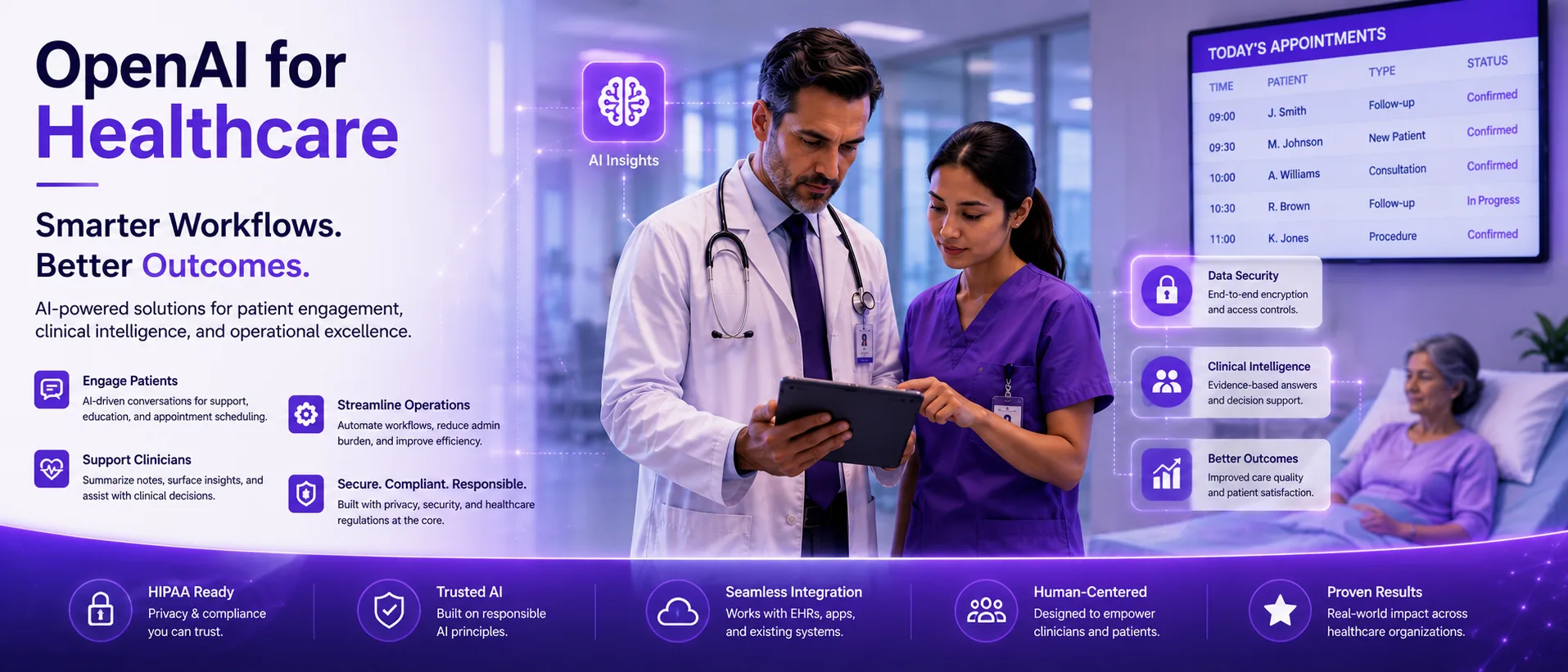
AI in healthcare is moving from theory to practice. Providers and digital health teams are now using OpenAI models to automate intake, summarize clinical notes, and guide patients through complex care journeys. According to the NYU Health Sciences Library, generative AI is gaining traction in major health systems, with OpenAI at the forefront of this shift. The recent launch of health-focused features in ChatGPT makes it easier for teams to build secure, compliant workflows that support both clinicians and patients (see OpenAI's announcement).
But new technology brings new questions: How do you integrate OpenAI safely? What are the real-world benefits and risks? This article breaks down what matters for decision-makers—covering best practices, use cases, and lessons from shipped platforms. If you're considering whether to build, buy, or partner for your next AI project, you'll find actionable insights and links to related healthcare software guides and Prompt Gurru's portfolio of wellness and EAP solutions. Let's explore how OpenAI is transforming patient care and operations, and what it means for your roadmap.
Overview of OpenAI Capabilities Relevant to Healthcare
Healthcare technology leaders are looking for AI solutions that do more than automate simple tasks—they want tools that fit into clinical workflows, improve patient care, and support regulatory requirements. OpenAI's latest healthcare-ready models and features are built to address these needs across patient engagement, clinical decision support, and operational efficiency.
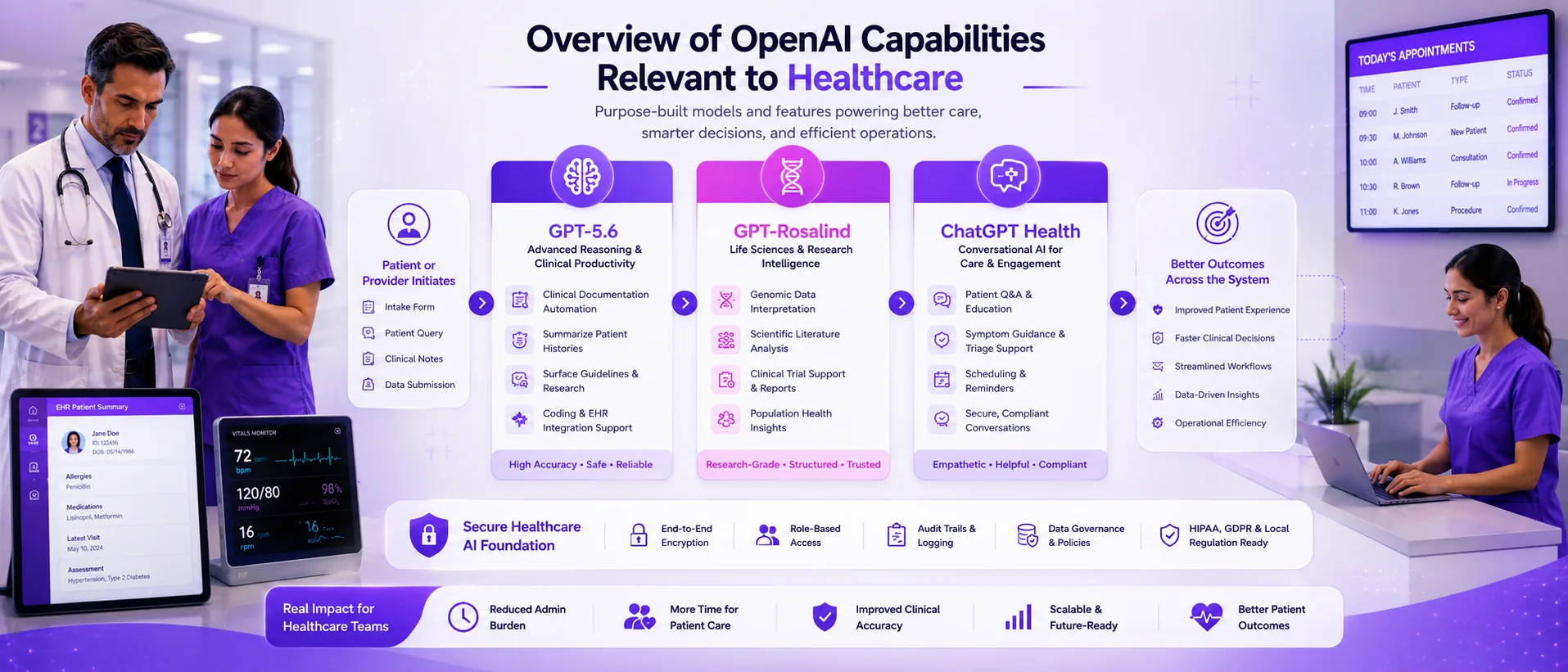
GPT-5.6 is OpenAI's flagship language model, designed for high-accuracy natural language understanding and advanced reasoning. In healthcare, GPT-5.6 can automate clinical documentation, summarize complex patient histories, and surface relevant medical research for providers. Its coding assistance features also help digital health teams accelerate EHR integrations and build custom AI-powered tools. For a technical deep dive, see the GPT-5.6 release overview.
GPT-Rosalind is purpose-built for life sciences and biomedical research. It excels at interpreting genomic data, analyzing scientific literature, and generating structured reports for clinical trials or population health studies. This model is especially valuable for research organizations and digital health product teams working with large, unstructured datasets. OpenAI's GPT-Rosalind announcement highlights its focus on responsible access and scientific advancement.
ChatGPT Health brings conversational AI into patient and provider workflows. With features designed for secure, compliant healthcare environments, ChatGPT Health can guide patients through symptom checkers, answer common questions, and support administrative staff with scheduling or triage. According to OpenAI's Health in ChatGPT update, these features are built with privacy and clinical safety in mind, and users are encouraged to verify information with licensed professionals.
Integrating these models into healthcare systems enables smarter clinical AI workflows—such as automated chart review, coding support, and natural language search across EHRs. For a broader industry perspective on AI in healthcare and best practices, NYU Health Sciences Library offers a specialty guide on AI in healthcare covering generative AI trends and real-world applications.
OpenAI healthcare integration is not just about deploying a chatbot—it's about embedding AI into the core of patient care and operations. To see how these integrations work in practice, check out our AI Integration Services article or explore our AI automation services for healthcare teams.
Key Use Cases: Patient Engagement, Clinical Decision Support, and Operations
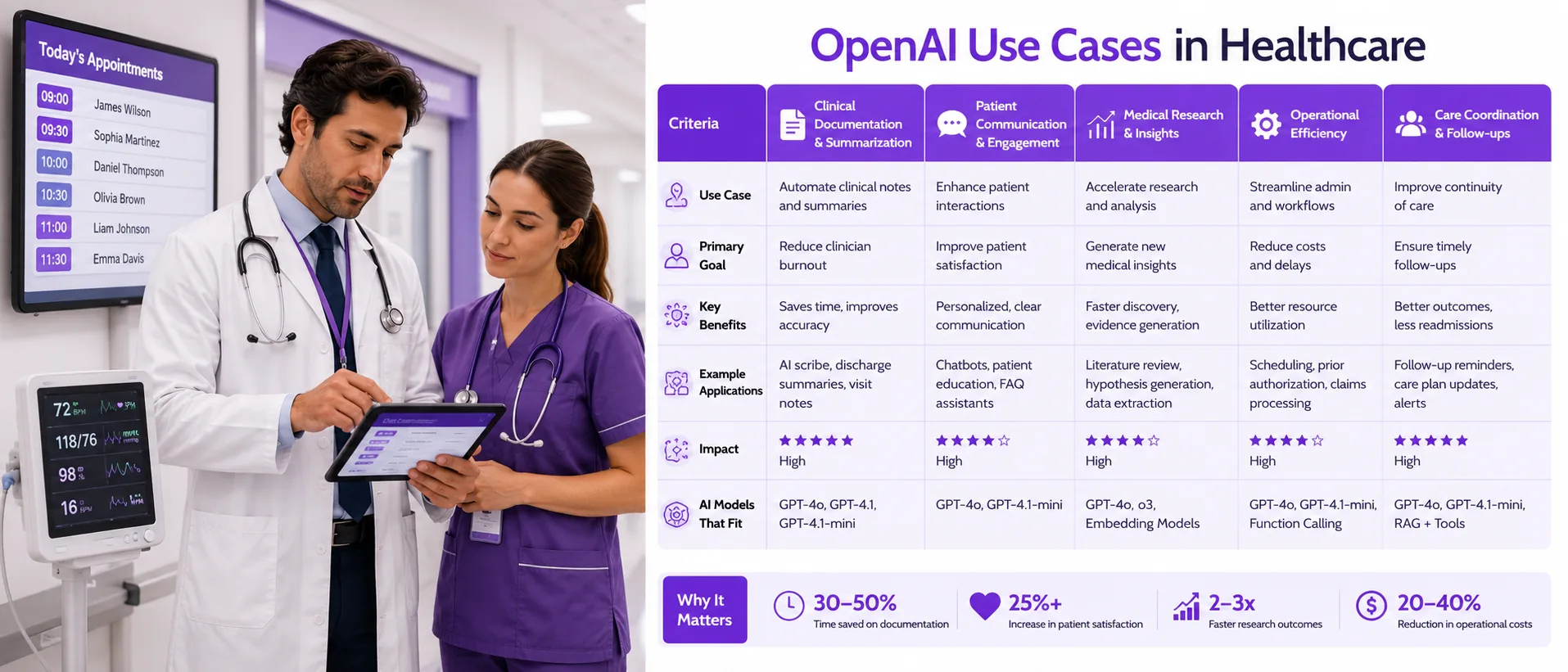
Healthcare leaders are looking for practical ways to apply AI that actually improve patient care and streamline operations. OpenAI's technology is already powering real healthcare AI applications across three core areas: patient engagement, clinical decision support, and operational efficiency.
Patient Engagement: Smarter, More Accessible Support
AI-driven chatbots and virtual assistants built with OpenAI models are now handling patient queries, appointment scheduling, and even pre-visit triage. For example, clinics can deploy conversational agents that answer FAQs, remind patients about medications, or guide them through symptom checkers. According to OpenAI's Health in ChatGPT release, these tools are designed to provide accurate information while encouraging patients to consult with their providers for medical decisions. The result: reduced call center load, faster response times, and improved patient satisfaction.
Clinical Decision Support: Augmenting Provider Workflows
OpenAI models can analyze unstructured clinical notes, summarize patient histories, and surface relevant guidelines for clinicians. This supports faster, more informed decision-making—especially in high-volume environments. For instance, AI can extract key findings from radiology reports or flag potential drug interactions. NYU Langone Health's AI in Healthcare guide highlights how generative AI is being used to assist with documentation and knowledge retrieval, freeing up clinicians to focus on patient care. However, it's critical to validate AI outputs and maintain human oversight to avoid errors or bias.
Operational Efficiency: Streamlining the Back Office
On the operations side, OpenAI tools automate repetitive tasks like insurance pre-authorizations, claims documentation, and even supply chain communications. AI-powered summarization can reduce the time spent on administrative paperwork, while natural language interfaces simplify data entry and reporting. As new models like GPT-5.6 emerge, the scope for automating complex workflows continues to expand. The main challenge is ensuring these automations integrate securely with EHRs and comply with healthcare regulations.
For healthcare organizations ready to explore these use cases, it's essential to start with clear goals and robust clinical AI workflows. If you're considering a custom build or want to see how these patterns fit your environment, check out our Healthcare & Fitness Software Development article or AI automation services for next steps.
Best Practices for Integrating OpenAI in Healthcare Systems
Integrating OpenAI into healthcare environments is a high-stakes process that demands a disciplined approach to security, compliance, and operational readiness. Healthcare AI best practices start with a clear understanding of regulatory frameworks—HIPAA, GDPR, and local health data laws must shape every OpenAI healthcare integration decision. Before deploying any AI-driven workflow, ensure all patient data is encrypted both in transit and at rest, and that strict access controls are in place at the application and infrastructure levels.
Model validation is critical. Every OpenAI-powered solution should be tested with real clinical scenarios and reviewed by qualified medical professionals before launch. This step helps prevent unsafe recommendations and ensures outputs align with clinical best practices. According to the NYU Health Sciences Library's AI in Healthcare guide, involving clinicians early in the design and validation process leads to safer, more effective deployments.
Operationally, successful OpenAI healthcare integration means mapping out where AI will add value—such as automating intake forms, summarizing patient histories, or supporting clinical decision-making. Set up feedback loops so users can flag questionable outputs and suggest improvements. OpenAI's own Health in ChatGPT documentation emphasizes the importance of human oversight and encourages users to verify AI-generated information with qualified healthcare providers.
User training is essential for adoption and safety. Staff should receive hands-on sessions covering how to interpret AI outputs, recognize limitations, and escalate concerns. Sharing best practices across teams—potentially through agent libraries or internal knowledge bases, as described in OpenAI's workspace agents—can accelerate learning and reduce risk.
Ethical use must remain front and center. Only use OpenAI models for applications that respect patient autonomy, privacy, and consent. Be transparent with patients and staff about when and how AI is being used. Document all integration decisions and maintain audit trails for compliance reviews.
For healthcare leaders considering OpenAI healthcare integration, following these best practices not only reduces risk but also builds trust with clinicians, patients, and regulators. If you need help mapping out a secure, compliant AI rollout, our team at Prompt Gurru has experience building and validating healthcare AI solutions. Learn more about our healthcare AI services or book a discovery call to discuss your project.
Case Study: AI-Powered Wellness Platform Inspired by Mindway (illustrative example)
For healthcare leaders evaluating AI in wellness and EAP, Mindway offers a practical blueprint. Mindway is a digital mental wellness platform built to deliver confidential support, expert guidance, and personalized care routing—powered by AI-driven workflows. Its core goal: make mental health resources accessible, responsive, and effective for users who need help, while reducing operational friction for providers.
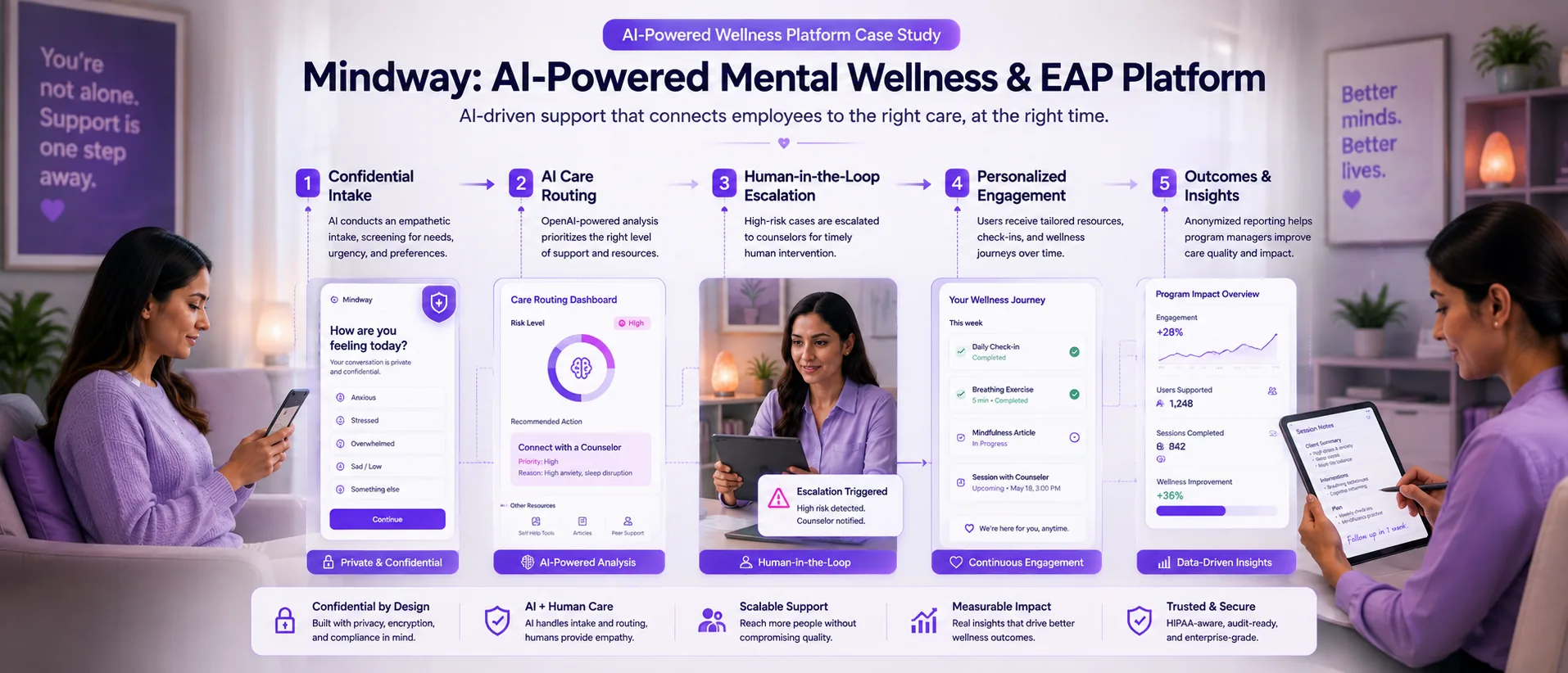
At the heart of Mindway's approach is the use of conversational AI, similar to OpenAI's models, to triage user needs and guide them to the right support. When a user initiates a session, the platform's AI agent conducts an empathetic, confidential intake—screening for urgency, risk, and preferred care modalities. This isn't just a chatbot: the workflow integrates with a secure backend, ensuring that sensitive data is handled in line with healthcare compliance standards.
For example, if a user expresses high stress or anxiety, the AI can recommend immediate self-help resources, suggest scheduling with a counselor, or escalate to a live support team if risk factors are detected. The system also supports ongoing engagement, nudging users to check in, complete wellness assessments, or access new content based on their history. This blend of automation and human-in-the-loop design increases reach and responsiveness, without overwhelming clinical staff.
Operationally, Mindway's platform automates much of the administrative overhead—routing cases, tracking engagement, and generating anonymized reports for program managers. This frees up clinical teams to focus on care, not paperwork. According to specialty guides like NYU Health Sciences Library, integrating AI in healthcare settings can streamline workflows and improve patient experience when implemented thoughtfully.
Prompt Gurru shipped Mindway as a full-stack solution, combining Flutter for mobile, secure cloud APIs, and OpenAI-powered conversational intelligence. For a closer look at the platform and its impact, see the Mindway portfolio case study.
- Healthcare & Fitness Software Development: Build Secure, Scalable Apps for Wellness and Care
- Practical Ways to Reduce Daily Stress: Effective Techniques for Busy Professionals
- Understanding Mindfulness and Its Benefits for Mental Wellness
- Portfolio case studies
- Contact Prompt Gurru
Security, Compliance, and Ethical Considerations in Healthcare AI
For healthcare leaders, integrating OpenAI into clinical and operational workflows raises critical questions about security, compliance, and ethics. Patient trust and regulatory scrutiny are non-negotiable, so every OpenAI healthcare integration must address HIPAA, local privacy laws, and the unique risks of clinical AI. This section breaks down what decision-makers need to know—and how to put healthcare AI best practices into action.
HIPAA and Data Privacy
In the US, HIPAA sets strict standards for protecting patient health information (PHI). Any AI system handling PHI—whether for patient engagement, clinical decision support, or workflow automation—must ensure encryption in transit and at rest, granular access controls, and audit trails. OpenAI's healthcare deployments are designed to support these requirements, offering secure API endpoints and options for data minimization. For global organizations, GDPR and other local regulations may also apply. For a practical overview, see NYU Health Sciences Library's AI in Healthcare guide.
Patient Consent and Transparency
Healthcare AI best practices require clear patient consent for data use, especially when generative models process sensitive information. OpenAI recommends informing patients when AI is involved in their care journey and clarifying what data is used and how. For example, OpenAI's Health in ChatGPT initiative guides users through secure interactions and encourages verification of medical information with a provider.
Bias Mitigation and Ethical Use
AI models can reflect or amplify biases present in training data. In healthcare, this can lead to unequal outcomes or missed diagnoses for underrepresented groups. OpenAI continues to refine its models to reduce bias and provides transparency on model limitations in model release notes. Healthcare organizations should combine AI outputs with clinical oversight and regularly audit for fairness and accuracy.
Best Practices for Secure and Ethical AI
To implement healthcare AI responsibly, follow these steps:
- Encrypt all PHI and restrict access to authorized staff only.
- Document patient consent and inform users when AI is used in care or operations.
- Regularly review AI outputs for bias, errors, and explainability.
- Stay current with evolving regulations and update workflows accordingly.
- Choose partners with a proven track record in healthcare AI best practices.
Prompt Gurru helps healthcare teams navigate these requirements by designing OpenAI-powered solutions that prioritize security, compliance, and ethical standards from day one. If you need guidance on secure AI integration or want a compliance review of your current workflows, see our healthcare AI services or book a discovery call.
DIY vs Hiring an AI Implementation Partner for Healthcare
Healthcare leaders weighing OpenAI for Healthcare face a core decision: should you build AI-powered solutions internally or bring in an experienced AI integration partner? Each approach comes with real tradeoffs, especially in a sector where compliance, patient safety, and operational reliability are non-negotiable.
DIY (In-House) Integration: Building in-house gives you direct control over architecture, data flows, and knowledge transfer. If your IT and data teams have deep experience with AI in healthcare, you might rapidly prototype and tailor solutions to your unique workflows. However, most organizations underestimate the complexity of integrating OpenAI models with EHRs, patient portals, and legacy systems. Regulatory hurdles—like HIPAA, audit trails, and data residency—add risk and can stall projects for months. According to the NYU Health Sciences Library, even top-tier health systems invest heavily in governance and best practices before deploying generative AI in clinical environments.
Hiring an AI Integration Partner: A specialized partner brings proven frameworks, healthcare domain knowledge, and a library of pre-tested integrations. This accelerates time to value and reduces compliance risk. Partners like Prompt Gurru have shipped real-world wellness and EAP platforms (see Mindway), so we know where AI projects stall and how to design for privacy, auditability, and clinical adoption from the start. You also get access to ongoing support, documentation, and team training—critical for operational handoff. The main tradeoff is cost: expert-led projects require upfront investment, but the reduction in rework, security gaps, and regulatory headaches often offsets this over the project lifecycle.
Key Decision Factors:
- Complexity: Integrating OpenAI with clinical systems, patient data, and existing workflows is rarely plug-and-play.
- Compliance: Partners help navigate HIPAA, audit logging, and consent management from day one.
- Speed: DIY teams may move fast on prototypes but slow down on production launches; partners deliver faster go-lives.
- Cost: Internal builds can appear cheaper but often balloon due to hidden compliance and maintenance work.
If you want to discuss your specific use case or see how an AI integration partner can accelerate your OpenAI for Healthcare project, contact Prompt Gurru or book a discovery call today.
Conclusion: Next Steps for Healthcare Leaders
OpenAI for Healthcare is no longer just a future promise—it's a practical toolkit that healthcare leaders can use today to improve patient care, streamline clinical operations, and drive measurable results. As highlighted throughout this article, AI-powered solutions are already making a difference in patient engagement, clinical decision support, and wellness platforms. The organizations that move now will be best positioned to lead in digital health innovation.
For decision-makers, the opportunity is clear: evaluate how OpenAI can be tailored to your unique healthcare environment, whether that's automating routine admin, supporting clinicians with real-time insights, or building custom workflows that fit your care model. The most successful projects focus on thoughtful integration, compliance, and working with partners who understand both healthcare and AI. If you're ready to move from research to action, Prompt Gurru brings hands-on experience building real-world healthcare AI products—including wellness platforms like Mindway—and can help you scope, design, and implement solutions that fit your goals.
Don't let uncertainty or technical barriers slow your progress. Read more about building secure, scalable healthcare apps, or explore our AI integration services for healthcare. When you're ready to discuss your specific use case, contact Prompt Gurru or book a free discovery call to map out your next steps. The future of healthcare is being built now—make sure your team is part of it.
FAQ: Common Questions About OpenAI in Healthcare
What benefits does OpenAI bring to healthcare?
OpenAI for Healthcare offers advanced natural language processing and generative AI capabilities that can enhance patient engagement, automate documentation, and support clinical decision-making. These tools help reduce administrative burden, improve care quality, and enable more personalized patient experiences. For a deeper dive into how AI is being used in clinical settings, see the NYU Health Sciences Library guide.
How do I ensure AI compliance in healthcare?
Ensuring compliance starts with selecting AI solutions that support HIPAA and other healthcare regulations. You should conduct regular risk assessments, maintain audit trails, and implement strict access controls. OpenAI recommends verifying all outputs and involving clinical staff in oversight, as highlighted in their Health in ChatGPT announcement. Always consult your legal and compliance teams before deploying new AI tools.
What is the timeline and cost for OpenAI integration?
Implementation timelines for OpenAI healthcare integration typically range from 8 to 20 weeks, depending on workflow complexity and EHR integration needs. Costs vary: off-the-shelf solutions may start at a few thousand dollars per month, while custom builds can run from $50,000 to $200,000+ (illustrative US agency ranges). These figures include discovery, development, testing, and training. For a tailored estimate, contact Prompt Gurru.
When should I hire an AI implementation partner?
If your team lacks in-house AI expertise, faces complex EHR or compliance requirements, or needs to move quickly, hiring a healthcare AI partner is usually the best route. An experienced partner can help you scope, build, and deploy OpenAI-powered workflows safely and efficiently. For more on this decision, see our post on AI integration services.
How does OpenAI improve clinical workflows?
OpenAI models can automate chart summarization, generate patient instructions, and assist with triage or intake, freeing up clinicians for higher-value tasks. Integrating OpenAI into clinical workflows reduces manual data entry and supports more informed, timely care decisions. For examples of best practices and workflow patterns, see OpenAI's workspace agents overview and our healthcare software development guide.
Still have questions about OpenAI for Healthcare or want to discuss your project? Book a discovery call with Prompt Gurru.
About the author
Prompt Gurru Team is a practitioner-led software studio specializing in healthcare AI, automation, and secure digital platforms for clinics, wellness providers, and EAPs. With over 5 years of hands-on experience, our team has delivered 50+ projects across healthcare, wellness, and clinical operations—including Mindway, an all-in-one mental wellness and EAP platform built for confidential care and scalable support.
Our expertise covers OpenAI-powered workflows, patient engagement tools, and HIPAA-aware integrations for healthcare leaders who need practical, compliant AI—not just demos. We work directly with founders, product owners, and clinical teams to design, build, and launch solutions that actually get used in real-world care settings.
See more healthcare AI and digital health case studies in our portfolio. If you are exploring OpenAI for healthcare or want to discuss a custom build, contact us or book a free discovery call to get started.
Ready to automate your business?
We build n8n workflows, AI pipelines, Flutter apps, and custom software for startups and SMEs - like the system that powers this blog.
Book a free discovery call