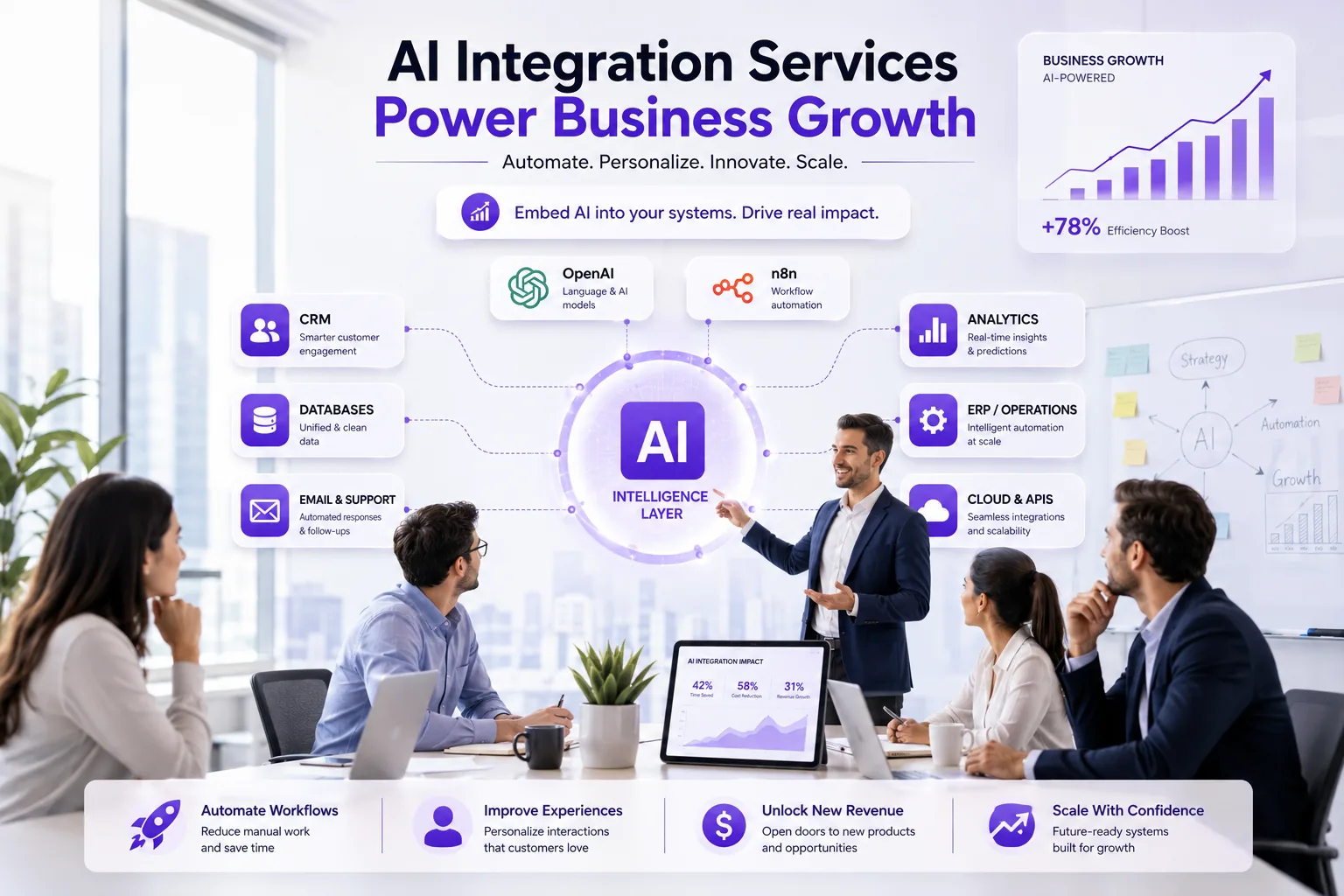
Learn how to successfully integrate AI technologies into your business systems with proven strategies, real-world examples, and expert guidance. This article helps founders, product owners, and operations leaders make informed build, buy, or hire decisions for AI integration.
Introduction: Why AI Integration Services Matter for Business Growth
For founders, product owners, and operations leaders, the question is no longer if you should adopt AI—but how to integrate it into your business systems with real impact. AI Integration Services are now a key driver for growth and competitive advantage, enabling teams to automate decisions, personalize experiences, and unlock new revenue streams without overhauling what already works.
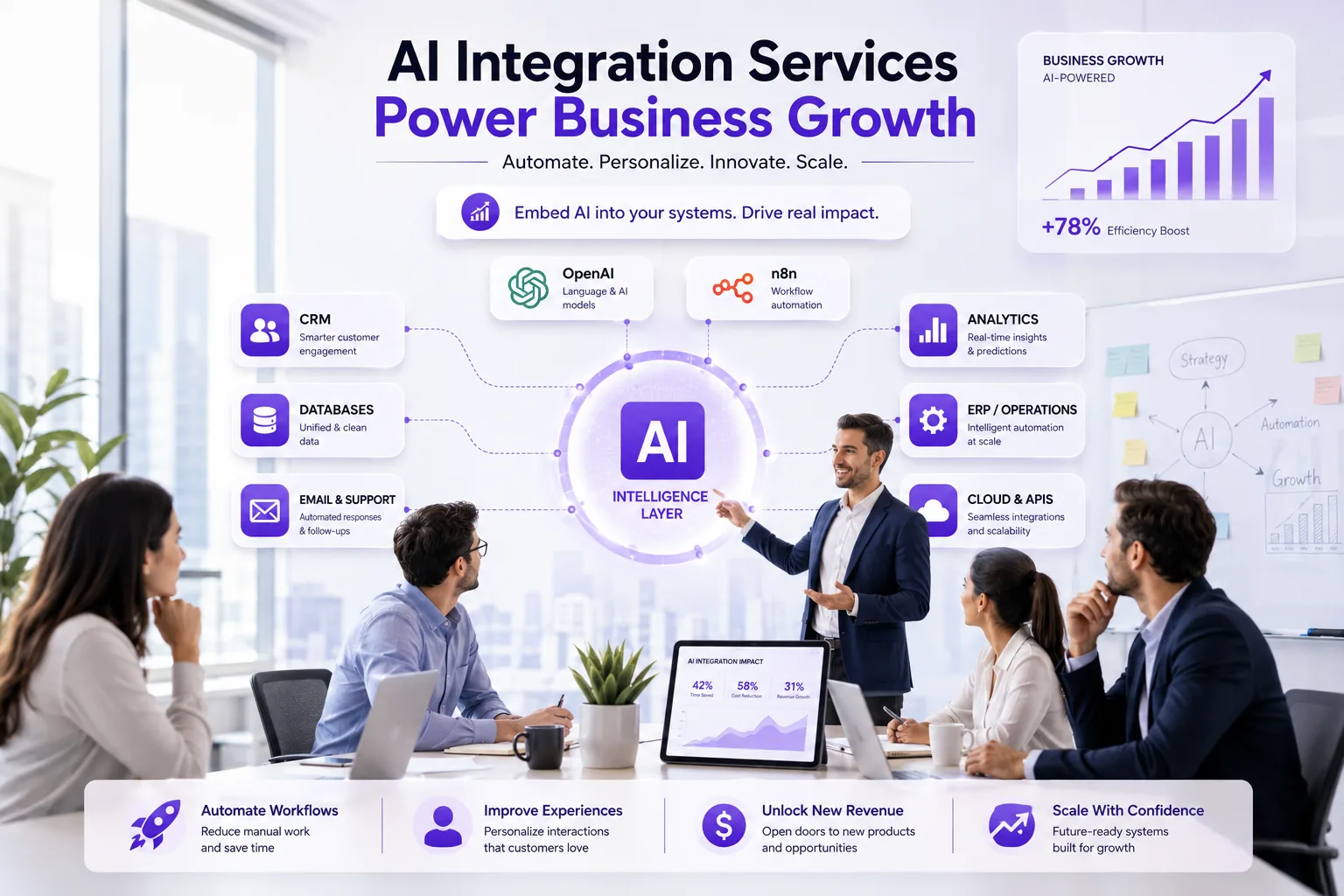
But the path to successful AI integration is full of decisions: Should you build custom machine learning workflows, buy off-the-shelf AI tools, or hire a specialist partner? Each route comes with its own tradeoffs in speed, cost, and control. This article is built for decision-makers who want practical, actionable answers—not just buzzwords. You'll get a clear roadmap to embedding AI, from understanding the core technologies to evaluating service providers and learning from real-world deployments.
We’ll cover proven AI integration best practices, common pitfalls, and what separates successful projects from expensive experiments. You’ll also see how organizations approach AI adoption in different industries, with links to in-depth guides and case studies—including when to hire a custom developer vs buy SaaS tools. If you’re ready to move from strategy to shipped AI features, this guide will help you make informed decisions for your stack and budget. For tailored help, see our AI automation services.
Understanding AI Integration: Key Concepts and Technologies
For founders and operations leaders, AI Integration Services mean more than just plugging in a chatbot or analytics tool. It's about embedding artificial intelligence into your business systems—so you can automate, optimize, and make smarter decisions at scale. But what does that actually involve, and which technologies matter most?
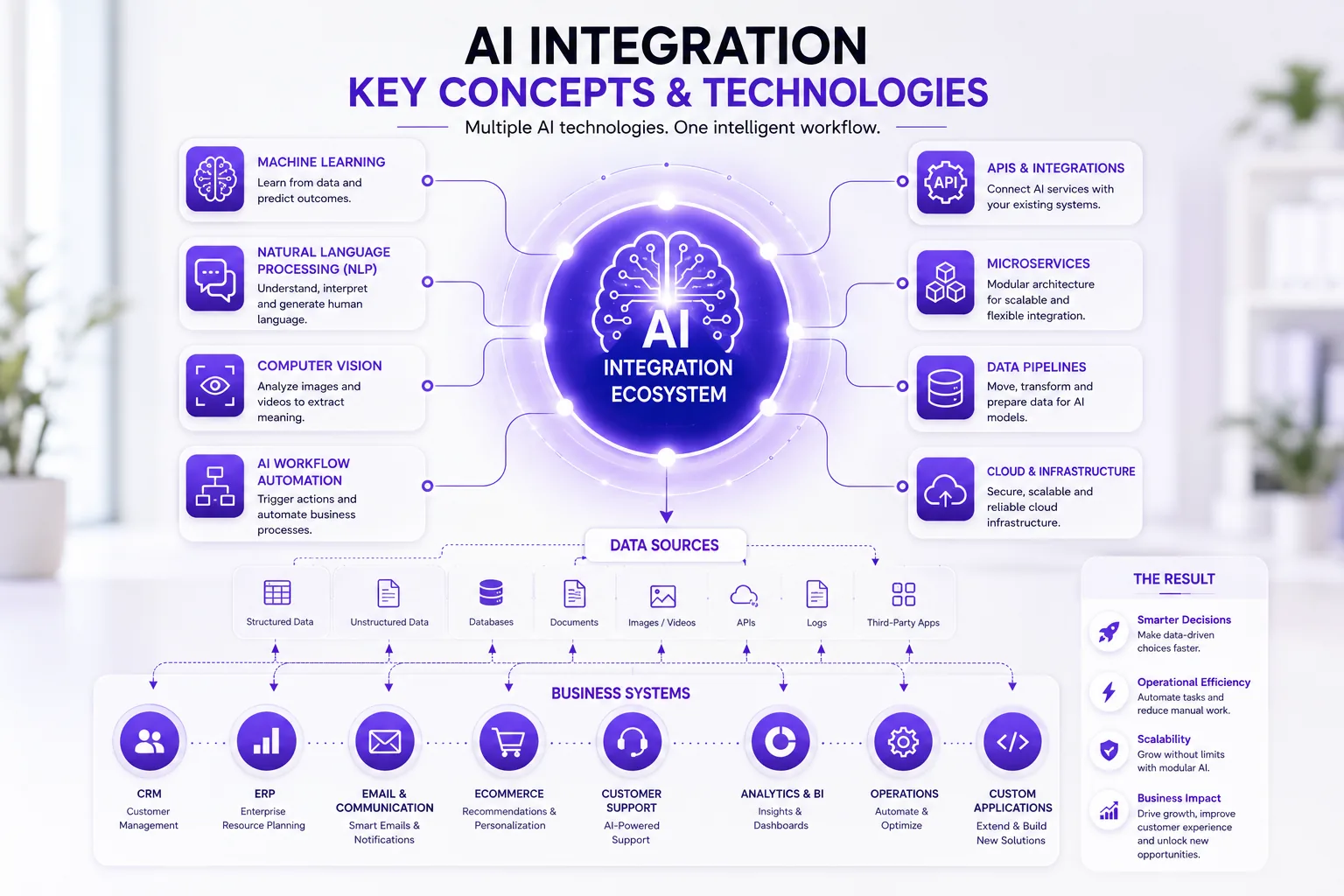
At a high level, AI integration is the process of connecting AI technologies—like machine learning (ML), natural language processing (NLP), computer vision, and workflow automation—directly to your business data and processes. Each technology brings unique strengths:
- Machine Learning (ML): ML models analyze patterns in your data to predict outcomes or automate tasks. For example, ML can forecast demand, detect fraud, or score leads inside your CRM.
- Natural Language Processing (NLP): NLP powers chatbots, virtual assistants, and document processing by enabling systems to understand and respond to human language. This is what lets support bots answer customer questions or auto-tag incoming emails.
- Computer Vision: Computer vision enables software to interpret images and video. In business, this can mean automated invoice scanning, product recognition in retail, or quality checks in manufacturing.
- AI Workflow Automation: This is where AI outputs trigger real actions—like updating records, sending alerts, or escalating issues—within your existing workflows. It connects the intelligence of AI with the day-to-day operations of your business.
Most modern AI integration happens through APIs and microservices, which allow you to connect AI features to your CRM, ERP, or custom platforms without rebuilding everything from scratch. Data pipelines are also crucial, since AI needs access to both structured (databases, spreadsheets) and unstructured (emails, images) data sources. According to industry guides, aligning the right AI technology with your business goals—and making sure your team understands its capabilities and limits—is key to success.
For example, Adobe Commerce integrates AI-powered recommendations and search directly into their storefront and backend, showing how AI can be woven into both customer-facing and internal systems. Government and enterprise teams are also adopting AI integration best practices, such as building repeatable control activities and ensuring data security (see BD Emerson's AI Integration Services).
If you want to see how AI chatbots and workflow automation fit into real-world business processes, check out our article on AI Chatbots and Lead Qualification Workflow Automation for Agencies and Growth Teams.
Common Challenges and Best Practices in AI Integration
Integrating AI into business systems is rarely a plug-and-play process. Most teams face three recurring challenges: data readiness, system compatibility, and security or compliance. According to industry research at Brickclay, a large share of AI projects stall because the underlying data is incomplete, inconsistent, or locked away in silos. If your data isn't clean and accessible, even the best machine learning integration will struggle to deliver value.
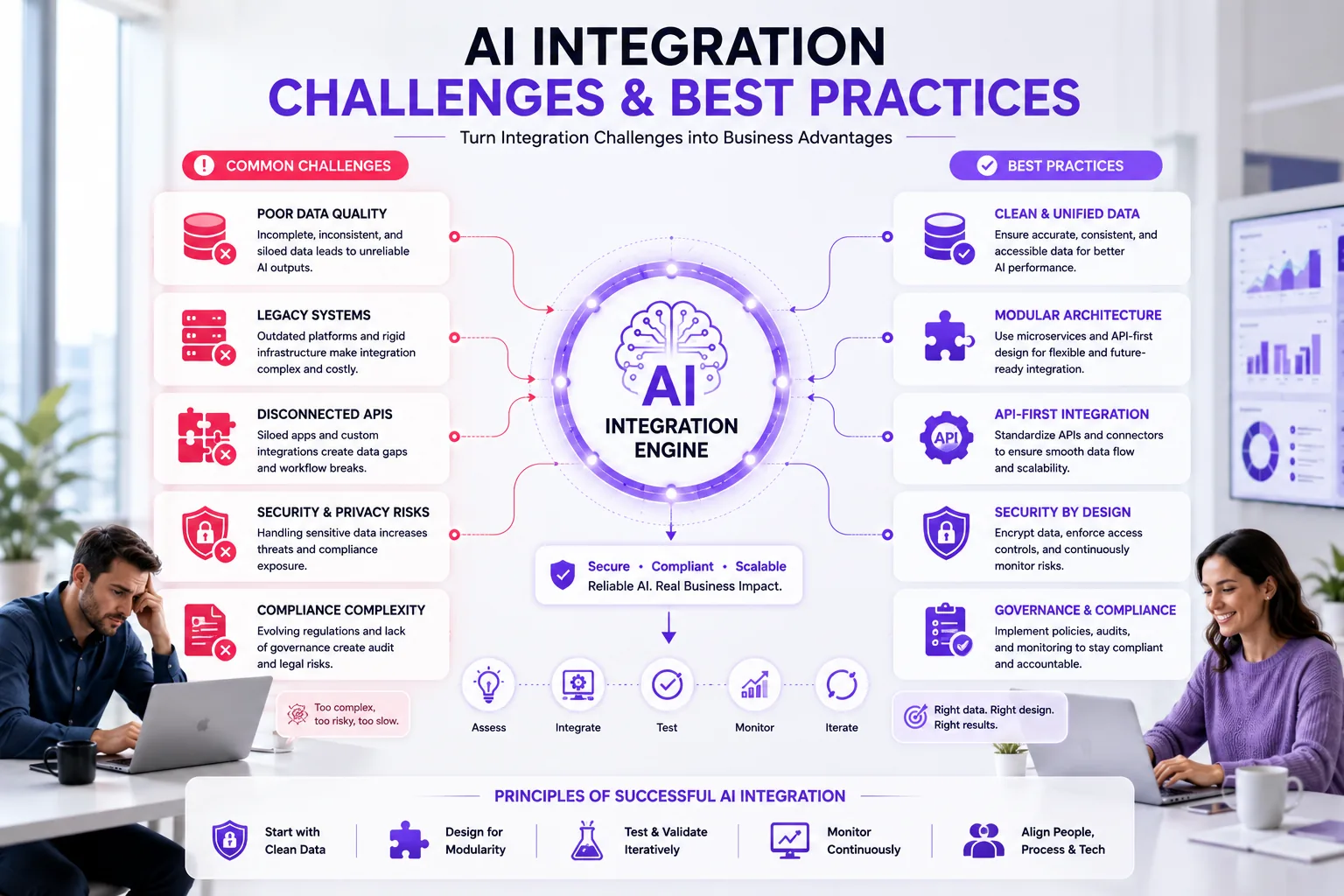
System compatibility is the next hurdle. Legacy platforms, custom APIs, and third-party SaaS tools often lack standardized integration points, making it tough to embed AI into existing workflows. As highlighted in the Adobe Commerce Services Guides, modular, API-driven architectures are essential for layering AI-powered features without breaking core business logic. Teams should map out data flows, identify integration gaps, and be ready to refactor legacy code where needed.
Security and compliance are non-negotiable. Embedding AI means handling sensitive business and customer data, raising the bar for privacy, access control, and regulatory compliance. BD Emerson recommends building repeatable control activities and continuous monitoring into your AI integration process to protect both data and systems.
So what are the best practices for AI integration? Start with a thorough data audit and cleansing phase before any AI workflow automation. Use modular architecture—think microservices and well-documented APIs—so you can add or update AI components without disrupting your stack. Prioritize iterative testing: deploy AI features in controlled environments, gather feedback, and refine models before scaling up. Always document integration points and data flows for future troubleshooting and audits. Finally, align your AI integration plan with compliance and governance policies from day one, not as an afterthought.
For more on deciding when to build custom integrations or buy off-the-shelf AI tools, see When to Hire a Custom Software Developer vs Buying SaaS Tools. If you need help mapping your integration strategy or want to see how Prompt Gurru approaches modular AI builds, check out our AI automation services.
Types of AI Integration Services: Build, Buy, or Hire?
When founders and operations leaders evaluate AI integration, the decision usually comes down to three main paths: build a custom solution, buy an off-the-shelf AI platform, or hire expert AI service providers. Each route offers distinct advantages and tradeoffs, so it pays to understand what fits your business goals, technical resources, and timeline.
- Build Custom AI Solutions: Building your own AI integration means developing machine learning models, APIs, or automation workflows tailored to your exact needs. This approach gives you maximum flexibility and control, making it ideal for organizations with proprietary data, complex workflows, or legacy systems that require deep integration. However, it demands significant investment in skilled talent, infrastructure, and ongoing maintenance. According to BD Emerson's AI integration guide, custom projects often require a discovery phase, iterative prototyping, and rigorous testing to ensure reliability and compliance. Expect longer timelines and higher upfront costs, but the payoff is a solution built for your unique context.
- Buy SaaS AI Platforms: Many companies choose ready-made AI platforms or APIs that offer features like natural language processing, image recognition, or predictive analytics. These solutions are fast to deploy, come with robust support, and often meet industry security standards out of the box. The tradeoff is less flexibility—you may need to adapt your processes to fit the tool, and ongoing subscription costs can add up over time. SaaS AI is a strong fit for standard use cases such as chatbots, document classification, or product recommendations. For example, Adobe Commerce's AI-powered services show how off-the-shelf AI can be integrated for product discovery and recommendations. Always review integration capabilities and data privacy policies before committing to a platform.
- Hire Expert AI Service Providers: Engaging an experienced AI integration partner can bridge the gap between custom and off-the-shelf. Service providers bring technical expertise, proven best practices, and the ability to tailor solutions to your stack and business needs. They can help with everything from workflow automation to machine learning integration, and often accelerate delivery by leveraging reusable components. This route is especially valuable if your team lacks in-house AI skills or bandwidth. As highlighted in the AI Guide for Government, external consultants are often brought in to complement internal teams and ensure successful adoption. Look for providers with a track record in your industry and clear communication around process, deliverables, and ongoing support.
Choosing the right approach depends on your technical resources, timeline, and the complexity of your AI goals. If you're weighing custom build versus SaaS, see our article When to Hire a Custom Software Developer vs Buying SaaS Tools for a deeper breakdown. For tailored advice or to explore how Prompt Gurru can help you integrate AI with confidence, book a discovery call.
Portfolio Example: AI Integration Patterns from Prompt Gurru’s Projects
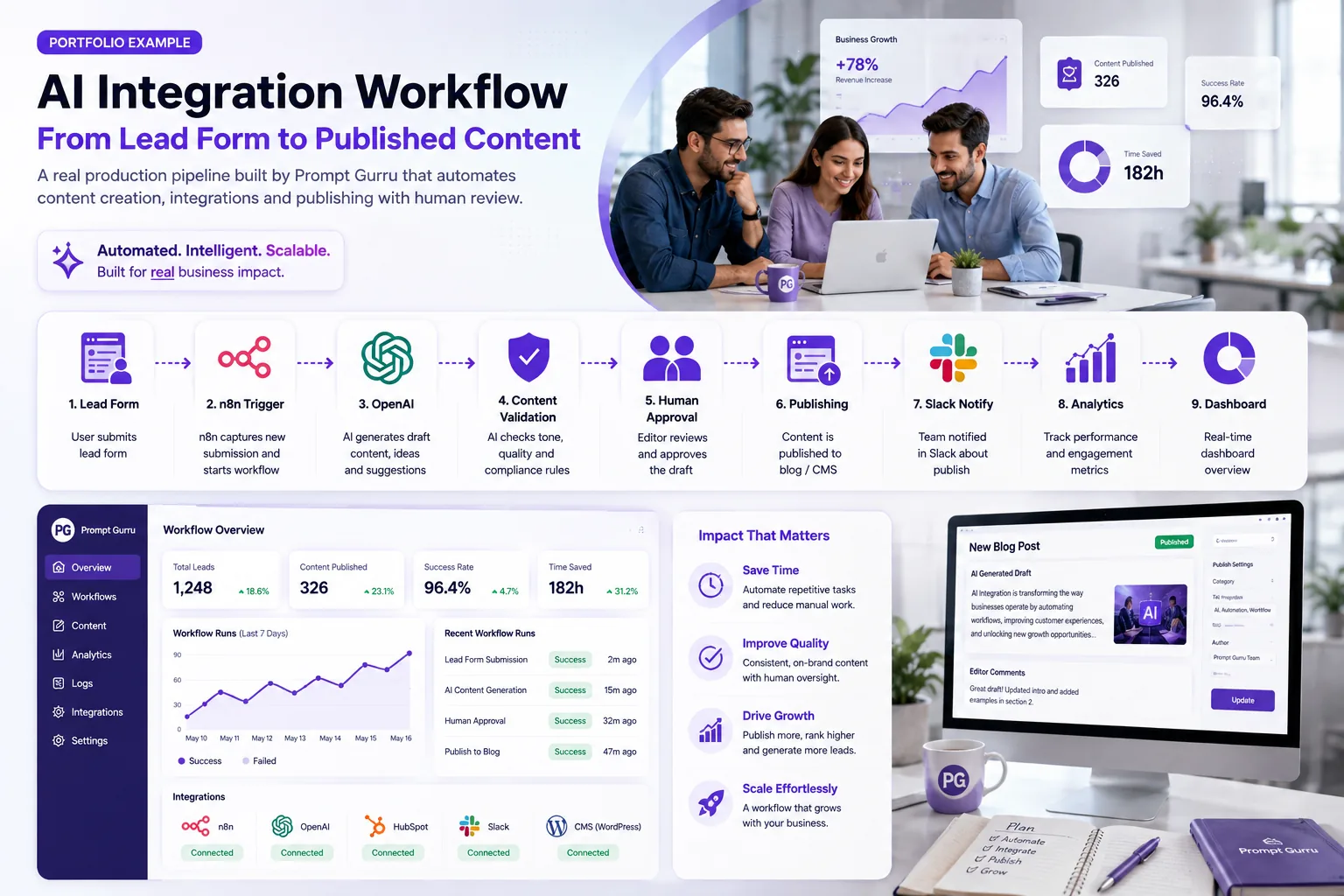
Seeing how AI integration works in practice is often the best way to understand what it takes to move from idea to production. At Prompt Gurru, we’ve delivered AI workflow automation that goes beyond demos—solving real business bottlenecks and scaling up content operations. One standout example is our Prompt Gurru Blogs automation pipeline (illustrative example), which demonstrates several integration patterns you can adapt for your own business systems.
Automated Content Workflows with AI
For our own blog, we built a custom pipeline that connects OpenAI’s language models with editorial review, compliance checks, and scheduled publishing. The workflow orchestrates topic rotation, draft generation, human-in-the-loop editing, and automated publishing—reducing manual effort and improving consistency. This pattern—combining best-in-class AI APIs with business logic and workflow automation—can be applied to document processing, customer support, or analytics in other industries. For more on these patterns, see this industry guide.
Integration Challenges and Solutions
A major challenge was aligning AI-generated content with our editorial standards. We solved this by layering in rule-based checks and human approvals, a best practice echoed by industry experts. We also implemented robust error handling and logging so issues are flagged instantly—critical for any production AI workflow. This approach matches recommendations from AI integration service providers who stress the importance of repeatable controls and process maturity.
Business Outcomes
Automating our content pipeline freed up our team for higher-value work, improved publishing speed, and made scaling sustainable. These same patterns—API orchestration, workflow automation, and human review—are relevant whether you’re integrating AI for e-commerce, internal analytics, or customer-facing tools. For more project examples, visit our Portfolio case studies or explore our AI automation services.
Step-by-Step Guide to Planning Your AI Integration Strategy
Integrating AI into your business systems is not just a technical project—it is a business transformation. To avoid wasted spend and false starts, you need a clear, actionable plan that brings together business goals, technical feasibility, and stakeholder alignment. Here is a practical step-by-step guide for founders, product owners, and operations leads planning AI integration:
- Clarify business objectives and define success metrics. Start by pinpointing what you want AI to achieve—such as automating repetitive workflows, improving customer experience, or surfacing new insights. Set measurable KPIs so you can track progress and ROI. For help identifying automation-ready processes, see our workflow audit guide.
- Assess data quality and integration points. Review the quality, structure, and accessibility of your data. Many AI projects stall due to poor data hygiene or disconnected systems, as highlighted in industry best practices. Map out where AI will plug into your current stack—CRM, ERP, or custom databases.
- Engage stakeholders from day one. Bring in IT, business leads, and end users early. Their input helps surface practical constraints and ensures buy-in. According to the AI Guide for Government, cross-functional collaboration is key to sustainable AI adoption.
- Choose the right AI technologies and partners. Evaluate whether off-the-shelf AI services, custom machine learning models, or workflow automation tools best fit your needs. Consider scalability, vendor support, and how easily new models can be updated or replaced. For a practical overview, see BD Emerson’s AI integration guide.
- Run a pilot or proof of concept. Test your AI integration on a limited scope—one workflow, department, or customer segment. This reduces risk and helps refine requirements before scaling up.
- Plan for scaling and continuous improvement. Once your pilot delivers value, develop a rollout plan for wider adoption. Build in feedback loops and monitoring to catch issues early and iterate on your solution. AI integration is rarely one-and-done; ongoing improvement is essential.
- Document, train, and support your team. Provide clear documentation and training for both technical and non-technical users. This ensures your investment delivers results and reduces support headaches down the line.
Following these steps will help you avoid common pitfalls and set your AI integration up for long-term success. If you are unsure where to start or need help with technical planning, read our workflow audit article or book a discovery call with Prompt Gurru for tailored advice.
Security, Compliance, and Data Governance in AI Integration
Security, compliance, and data governance are foundational to any successful AI integration project. When embedding AI into business systems, you must address how sensitive data is handled, ensure regulatory requirements are met, and maintain trust with both customers and stakeholders.
Data privacy is the first checkpoint. Before deploying AI, clarify what data your models will access and process. If your systems touch customer, financial, or health data, you need policies for collection, storage, and sharing. Many organizations align with frameworks like GDPR, HIPAA, or CCPA, depending on their industry and geography. The AI Guide for Government recommends vetting every AI tool for privacy and security before it goes live.
Regulatory compliance covers more than privacy. It includes how AI decisions are made, logged, and explained. For example, if your AI is used in hiring or credit scoring, you may need to demonstrate fairness and auditability. Some organizations create internal AI review boards or policies to ensure ongoing compliance. The TSAHC RFP for AI Integration highlights the need for robust guidelines and a process to vet new AI tools for both utility and risk.
Secure data handling is non-negotiable. This means encrypting data in transit and at rest, using granular access controls, and regularly auditing who can access or modify sensitive information. Industry guides like BD Emerson's AI Integration Services stress the importance of repeatable control activities to mature your security posture over time.
Data governance frameworks provide structure for managing data quality, lineage, and accountability. This includes defining data ownership, labeling, and tracking, as well as monitoring AI outputs for drift or bias. Teams often adapt best practices from established frameworks or government and enterprise AI guides to fit their own risk profile.
Tip: Involve legal, compliance, and IT security teams early in your AI integration project. Building trust starts with transparency and proactive risk management.
For more on how Prompt Gurru approaches secure and compliant AI integration, see our AI automation services or contact us for a discovery call.
Evaluating AI Service Providers and Custom Development Partners
Choosing the right partner for AI Integration Services is a critical step that can impact your project's success, timeline, and ROI. Whether you're weighing custom AI solutions or established service providers, a structured evaluation process helps you avoid misalignment and costly mistakes. Here are five practical criteria to guide your decision:
- 1. Technical Expertise and Stack Fit: Look for partners with hands-on experience in the specific AI technologies you need—such as machine learning integration, natural language processing, or AI workflow automation. Ask about their preferred frameworks, cloud platforms, and how they handle integration with your current systems. For a deeper look at AI integration best practices, see this industry guide.
- 2. Portfolio and Relevant Use Cases: Review recent projects that match your requirements. A strong portfolio with real-world examples—especially in your industry or with similar data challenges—signals practical know-how. Request references or case studies to validate claims. For example, Prompt Gurru’s shipped work covers mobile apps, web platforms, and custom AI solutions for startups and SMEs.
- 3. Security, Compliance, and Data Handling: AI integration often involves sensitive business data. Ensure your partner follows strong security practices, understands compliance standards, and can document their approach to data governance. Strategic guidance on repeatable control activities, as described by BD Emerson, is a good sign.
- 4. Support, Training, and Documentation: Post-launch support is critical for long-term success. Ask about onboarding, documentation, and how ongoing maintenance or updates are handled. Providers should offer clear communication channels and training for your team.
- 5. Proposal Quality and Business Alignment: A strong proposal should outline solution architecture, timeline, deliverables, and how the approach aligns with your business objectives. Look for transparency around project phases, risks, and revision scope. For tips on vetting proposals and aligning with your goals, see the AI Guide for Government.
Tip: Always compare custom AI solutions with off-the-shelf options. If your needs are unique or require deep integration, a custom build may be the best fit. For more on this decision, check out When to Hire a Custom Software Developer vs Buying SaaS Tools.
Ready to discuss your AI integration project or want a second opinion on a proposal? Contact Prompt Gurru for a discovery call with our practitioner team.
DIY vs Hiring Experts: Tradeoffs and Decision Criteria
Founders and operations leaders weighing AI Integration Services face a classic choice: build in-house or hire external experts. Both paths have real implications for cost, speed, risk, and long-term scalability. Here’s how to think through the decision using AI integration best practices and what we’ve seen work in the field.
- DIY (In-House Build)
Pros: Full control over your architecture, data, and roadmap. If your team already has machine learning integration skills, you can tailor every detail and retain all intellectual property. Internal builds may save on vendor fees and allow for rapid iteration on business priorities.
Cons: Steep learning curve if your team is new to AI workflow automation or custom AI solutions. Many internal projects stall due to gaps in data readiness, integration expertise, or evolving best practices—see industry research on common pitfalls. Ongoing maintenance, model updates, and compliance can stretch resources thin, especially as AI services and APIs change. - Hiring Experts (External Partners)
Pros: Access to proven AI service providers who bring specialized experience, up-to-date security and compliance knowledge, and established integration patterns. Partners like Prompt Gurru can accelerate delivery, reduce risk, and help you avoid mistakes seen across industries. You also get documentation, training, and support—critical for scaling and future-proofing your investment. For more on how outside consultants add value, see the AI Guide for Government and BD Emerson’s integration services guide.
Cons: Higher upfront investment and less direct control over daily development. You’ll need to clearly define requirements, success metrics, and manage vendor handoff for long-term maintainability. Choosing the right partner is key—look for a track record in your industry and transparent communication.
Decision Criteria: If your team has deep AI and workflow automation skills, and your project isn’t mission-critical, DIY can work—especially for smaller pilots. But if speed, scalability, and risk mitigation matter, or if you’re embedding AI into complex business systems, hiring experts is usually the smarter move. Many organizations blend both: start with external guidance to set up best practices, then build internal capacity over time. For a tailored recommendation, book a free discovery call or contact Prompt Gurru to explore the best fit for your AI integration project.
Frequently Asked Questions about AI Integration Services
What are AI integration services?
AI integration services help businesses embed artificial intelligence and machine learning capabilities into their existing systems, workflows, or products. These services cover everything from connecting AI APIs to building custom models, ensuring the new solutions work smoothly with your current tech stack. Learn more in this comprehensive guide.
How much do AI integration projects cost?
Costs vary based on project scope, data complexity, and whether you choose off-the-shelf tools or custom AI solutions. Simple API integrations can start in the low five figures, while custom machine learning projects may run from $20,000 to $100,000+ (illustrative US agency ranges). Ongoing costs include cloud hosting, maintenance, and model updates. For a tailored estimate, contact Prompt Gurru.
What is the typical timeline for AI integration?
Most AI integration projects take 4 to 16 weeks, depending on requirements, data readiness, and stakeholder involvement. Quick wins like connecting prebuilt AI services can be delivered faster, while custom workflows or deep integrations require more planning and testing. Following AI integration best practices helps avoid delays.
Should I build AI integration in-house or hire experts?
If your team has strong AI and integration experience, building in-house can offer more control. However, most organizations benefit from hiring AI service providers who bring proven workflows, security know-how, and faster delivery. For complex or regulated environments, expert partners reduce risk and accelerate results. See our in-depth comparison.
How do I choose the right AI service provider?
Look for a provider with a track record in your industry, clear communication, and expertise in both AI and systems integration. Ask for portfolio examples, references, and details on their approach to security and data governance. For more on evaluating partners, check out this industry guide or Prompt Gurru's case studies.
About the Author
Prompt Gurru is a practitioner-led software studio with over 5 years of experience delivering AI automation, custom web applications, and mobile solutions for startups and SMEs. Our portfolio includes shipped products like Max Invoice, Max HR, Mindway, and Makflip—live on Google Play, the App Store, and the web.
We work directly with founders and product teams to design, build, and integrate AI-driven features, from workflow automation to custom machine learning solutions. Our expertise spans n8n workflow orchestration, OpenAI API integrations, CRM and marketing automation, and scalable cross-platform apps. Clients trust us for practical delivery, clear communication, and results that scale.
Ready to discuss your AI integration project? Contact Prompt Gurru or book a free discovery call to explore how we can help embed AI into your business systems.
Ready to automate your business?
We build n8n workflows, AI pipelines, Flutter apps, and custom software for startups and SMEs - like the system that powers this blog.
Book a free discovery call