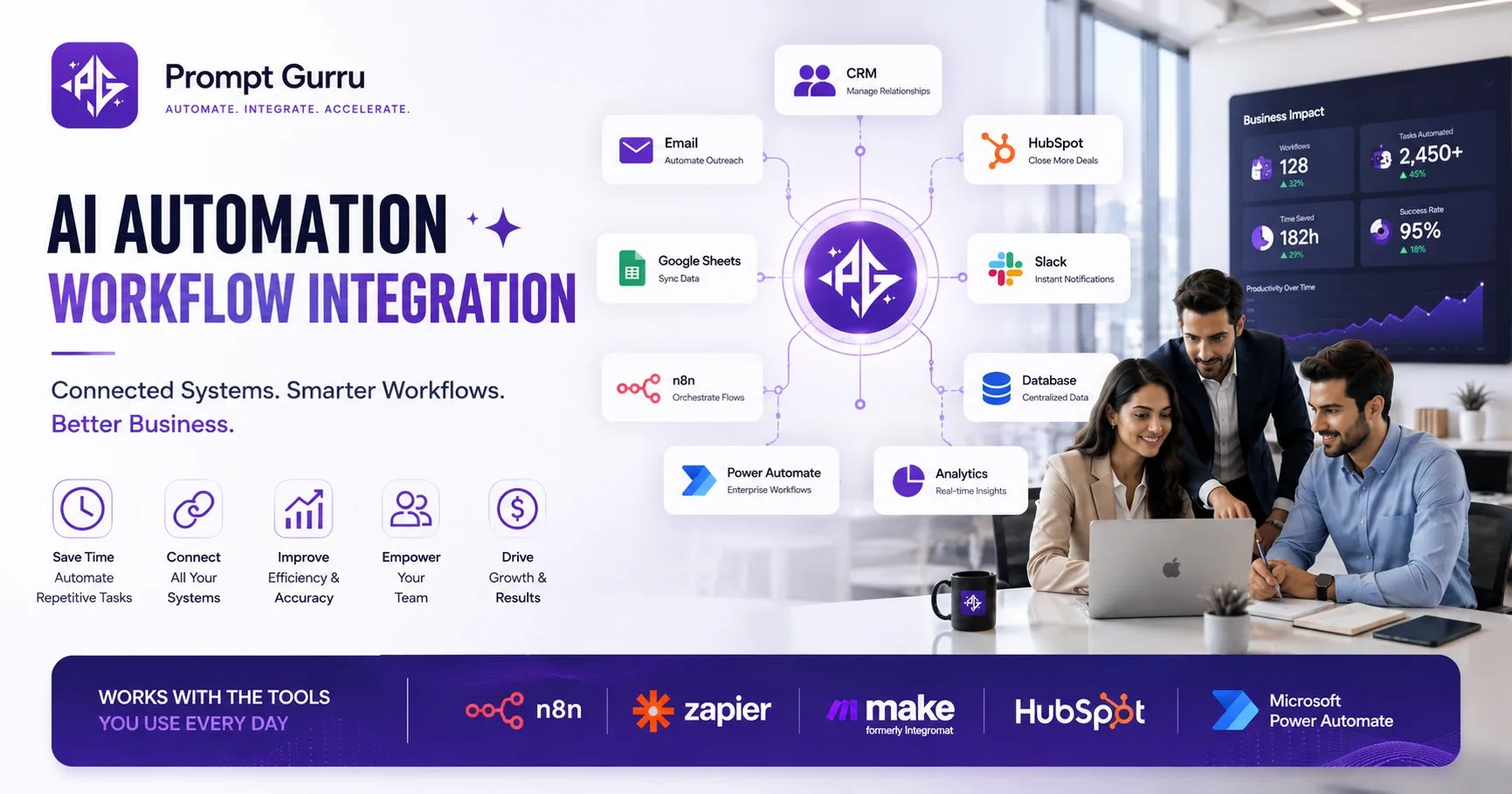
Discover how Prompt Gurru leverages AI automation and workflow integration to streamline your business processes and improve operational efficiency. This article guides decision-makers through the benefits and practical applications of Prompt Gurru's services, helping you make informed choices for custom implementation or partnership.
Introduction: Why AI Automation and Workflow Integration Matter for Your Business
Operations leaders and product owners are under constant pressure to deliver results with fewer resources. Manual processes, scattered data, and disconnected systems slow teams down and drain margins. This is where AI automation and workflow integration make a real difference. By automating repetitive tasks and connecting your business tools, you can streamline operations, reduce errors, and free up your team for higher-value work.
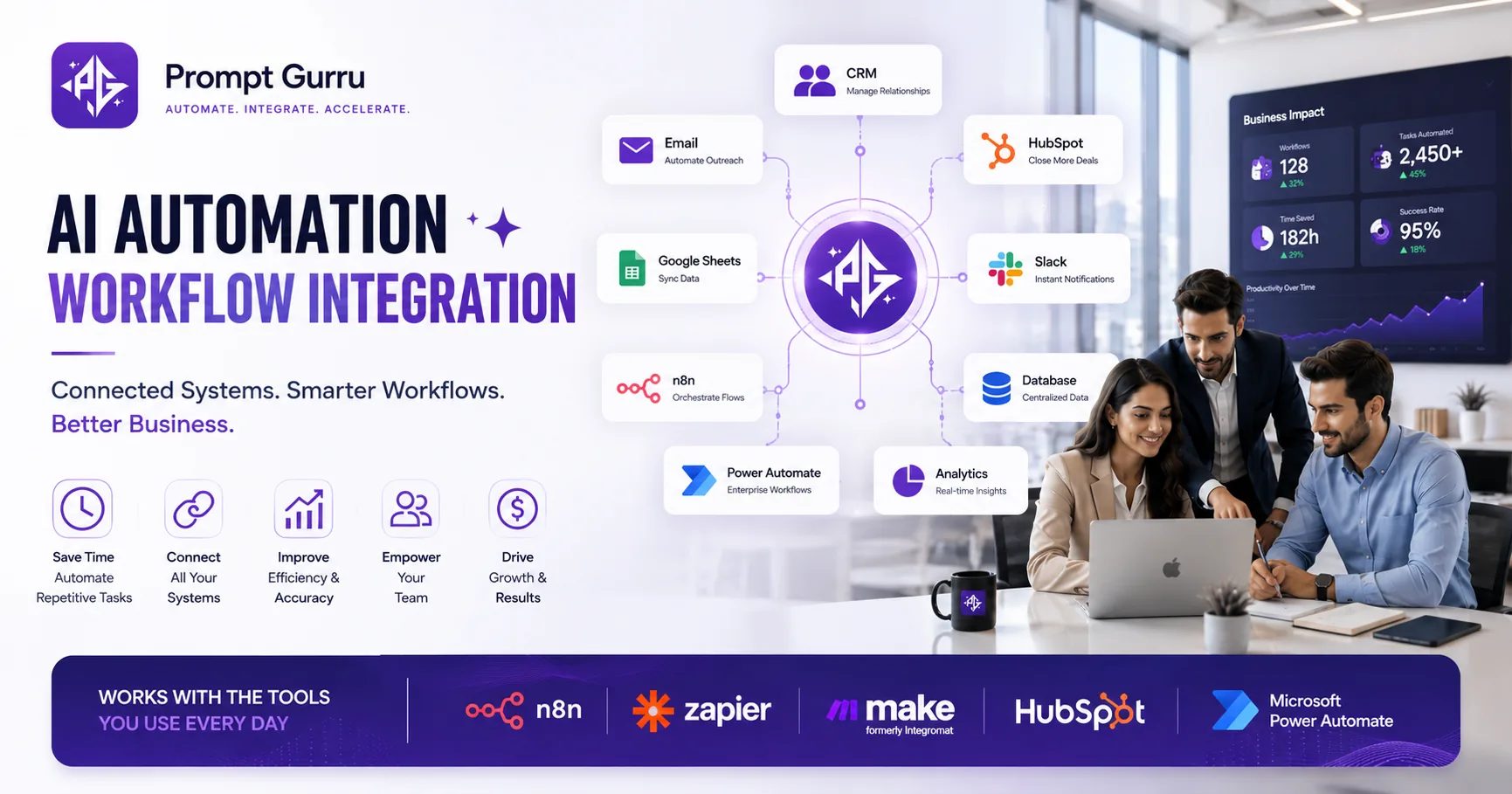
AI automation uses machine intelligence to handle logic-driven or repetitive activities—think data entry, document processing, or triaging support tickets. Workflow integration connects your apps, databases, and communication channels so information moves automatically, eliminating the need for constant copy-paste or manual follow-ups. Together, these strategies can transform how your business operates, boosting efficiency, accuracy, and responsiveness.
Industry leaders are already seeing the impact. For example, Microsoft 365 Copilot's release notes highlight how prompt scheduling automation reduces manual effort and ensures timely agent responses. Y Combinator's 2026 portfolio features workflow automation startups focused on integrating AI agents with ERPs, spreadsheets, and supplier portals (see YC workflow automation companies).
Prompt Gurru specializes in AI automation and workflow integration for businesses ready to scale. Our team designs and implements custom solutions that connect your systems, automate your processes, and help you move faster—without the chaos of disconnected tools. If you're considering automating your workflows or embedding AI into your operations, explore our AI automation services or read our guide to seamless AI integration for practical examples and next steps.
Understanding AI Automation and Workflow Integration Fundamentals
For operations leaders and founders, AI automation and workflow integration are no longer just buzzwords—they are essential to running an efficient, competitive business. At a basic level, AI automation means using artificial intelligence to automate tasks that used to require human input, while workflow integration connects your different tools and processes so information moves smoothly across your business.
What does AI automation look like in practice? AI automation uses technologies like machine learning, natural language processing, and AI agents to handle repetitive or decision-based work. For example, AI can sort incoming emails, extract key data from invoices, or trigger actions based on real-time events. Unlike simple rule-based automations, AI-powered workflows can adapt and improve as they process more data—making them ideal for dynamic business environments.
Workflow integration is about connecting software, databases, and business processes so that data flows automatically between them. When combined with AI, this means you can automate complex processes—like onboarding a new customer, routing support tickets, or syncing inventory between sales channels—without manual handoffs. According to Microsoft 365 Copilot release notes, embedding AI in business workflows can reduce manual effort and ensure timely responses for routine tasks.
For SMEs and startups, common use cases for AI automation and workflow integration include:
- Automated lead qualification and CRM updates
- Invoice processing and payment reminders
- Customer support ticket triage and response
- Syncing data between marketing, sales, and operations tools
Popular tools in this space include open-source workflow orchestrators like n8n, visual builders such as Zapier and Make, and AI platforms that can be plugged into these workflows. As noted by Coworker AI, platforms like n8n are gaining traction for their flexibility and ability to combine workflow automation with AI agent capabilities. Meanwhile, startups funded by Y Combinator are pushing the limits with AI agents that execute work across ERPs, emails, and supplier portals (see YC's workflow automation portfolio).
Understanding these fundamentals helps decision-makers choose the right mix of custom AI workflows and integration services for their business. For a deeper dive into practical tools and real-world examples, see our guide on AI Automation Tools for Small Business 2026. If you're considering custom automation or integration, explore our AI automation services to see how Prompt Gurru can help.
How Prompt Gurru Approaches AI Automation: Tools, Techniques, and Customization
Prompt Gurru’s approach to AI automation and workflow integration is built around flexibility, technical depth, and a focus on business outcomes. We don’t believe in one-size-fits-all automation. Every client gets a tailored solution that matches their unique processes, tech stack, and operational goals.
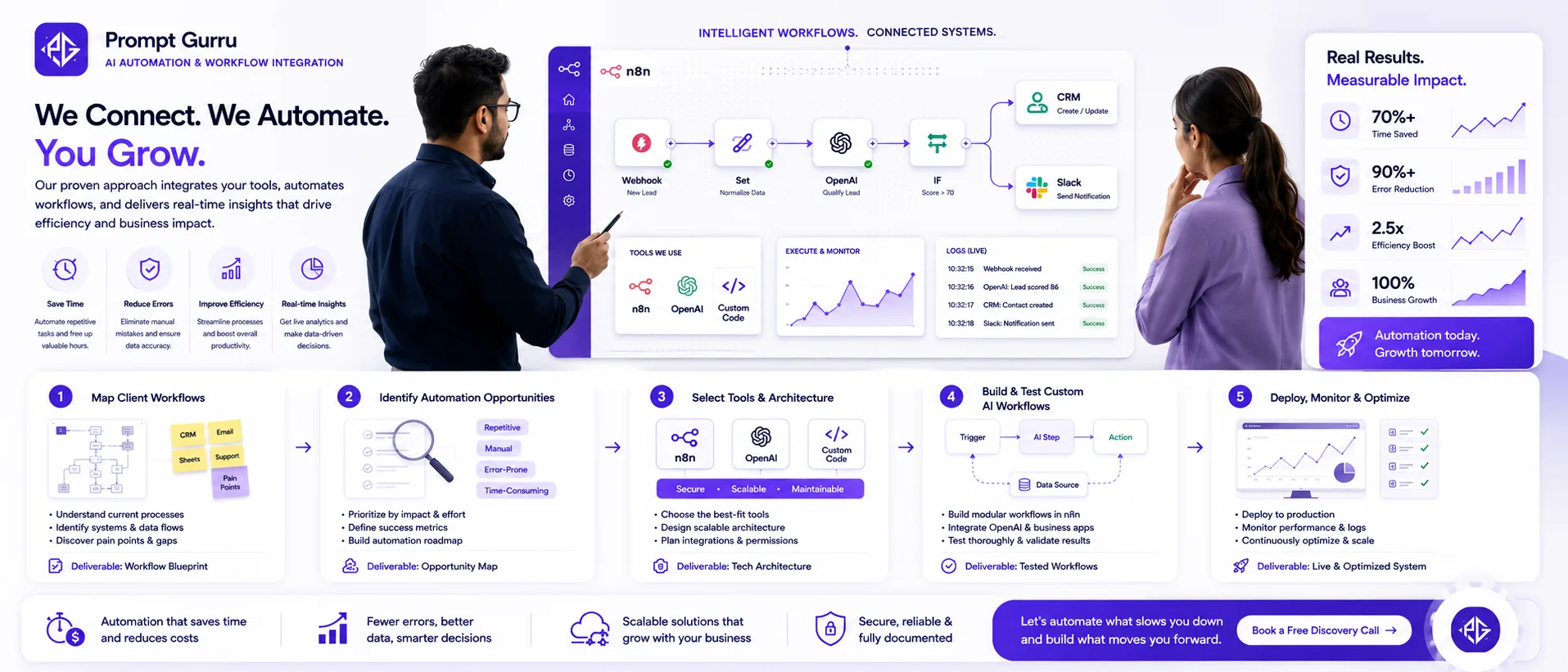
Our team starts by mapping your current workflows and identifying high-impact automation opportunities. We use a blend of open-source and commercial tools, including n8n for workflow orchestration, OpenAI for advanced AI steps like natural language processing or content generation, and custom Python or Node.js scripts for specialized integrations. This toolkit lets us build custom AI workflows that automate everything from lead qualification and document processing to multi-system data sync and real-time notifications.
For example, a typical engagement might involve integrating your CRM, email, and internal databases so that AI agents can trigger actions based on customer behavior or data changes. We prioritize clean, maintainable automation—borrowing best practices from industry leaders like those featured in Coworker AI’s review of workflow platforms and the latest Microsoft Copilot release notes on prompt-driven automation.
What sets Prompt Gurru apart is our commitment to client adaptation. We don’t just connect APIs—we design automations that fit your business logic, compliance needs, and team workflows. Whether you need a lightweight automation for a single process or a scalable system that coordinates AI agents across multiple departments, we’ll scope, build, and document it so your team can own and evolve the solution over time.
If you want to see our approach in action, explore our portfolio case studies or learn more about our AI automation services. We’re always happy to discuss how custom AI workflows can streamline your business and free up your team for higher-value work.
Key Benefits of Partnering with Prompt Gurru for Workflow Integration
Choosing Prompt Gurru for your AI automation and workflow integration needs means you get more than just technical implementation. Our approach is focused on delivering measurable business outcomes that matter to operations leaders, product owners, and founders.
- Efficiency gains that show up in your bottom line: We design custom AI workflows that automate repetitive, manual tasks—freeing your team to focus on higher-value work. This translates to faster turnaround times, fewer errors, and smoother operations. As seen in recent industry releases, automating prompt scheduling and routine workflows can significantly reduce manual effort and ensure timely responses.
- Scalability for growing businesses: Our solutions are built to scale with your needs. Whether you're handling a handful of processes or orchestrating thousands of transactions, we architect workflows that adapt as your business grows—without constant rework or ballooning costs. This is especially important in sectors where AI agents and automation must operate across ERPs, spreadsheets, and supplier portals, as highlighted by recent workflow automation startups.
- Reduced manual workload and human error: By integrating AI automation into your business processes, you minimize the risk of mistakes that come from manual data entry or repetitive tasks. Our team focuses on clean, maintainable workflow design, following best practices outlined in resources like Coworker AI's workflow automation guide.
- Improved decision-making with real-time insights: Prompt Gurru's custom AI workflows can surface actionable data right when you need it. This means your team can make informed decisions faster, with up-to-date information flowing automatically between systems.
- Seamless integration with your existing stack: We don't force you to rip and replace. Our workflow automation services are designed to connect with your current tools, CRMs, and data sources, so you get the benefits of AI automation without disrupting your day-to-day operations.
When you partner with Prompt Gurru, you get a team that understands both the technology and the business context. If you're ready to see how AI automation and workflow integration can transform your operations, explore our services or book a discovery call today.
Case Study: AI Automation in Action with Prompt Gurru’s Portfolio
Many businesses struggle to keep their content pipelines consistent and relevant, especially when scaling up. Manual blog management is time-consuming and error-prone, and generic automation tools rarely fit niche editorial needs. Prompt Gurru tackled this challenge head-on with the Prompt Gurru Blogs project—an automated blog publishing system designed to rotate through industry niches, maintain editorial quality, and showcase real portfolio work.
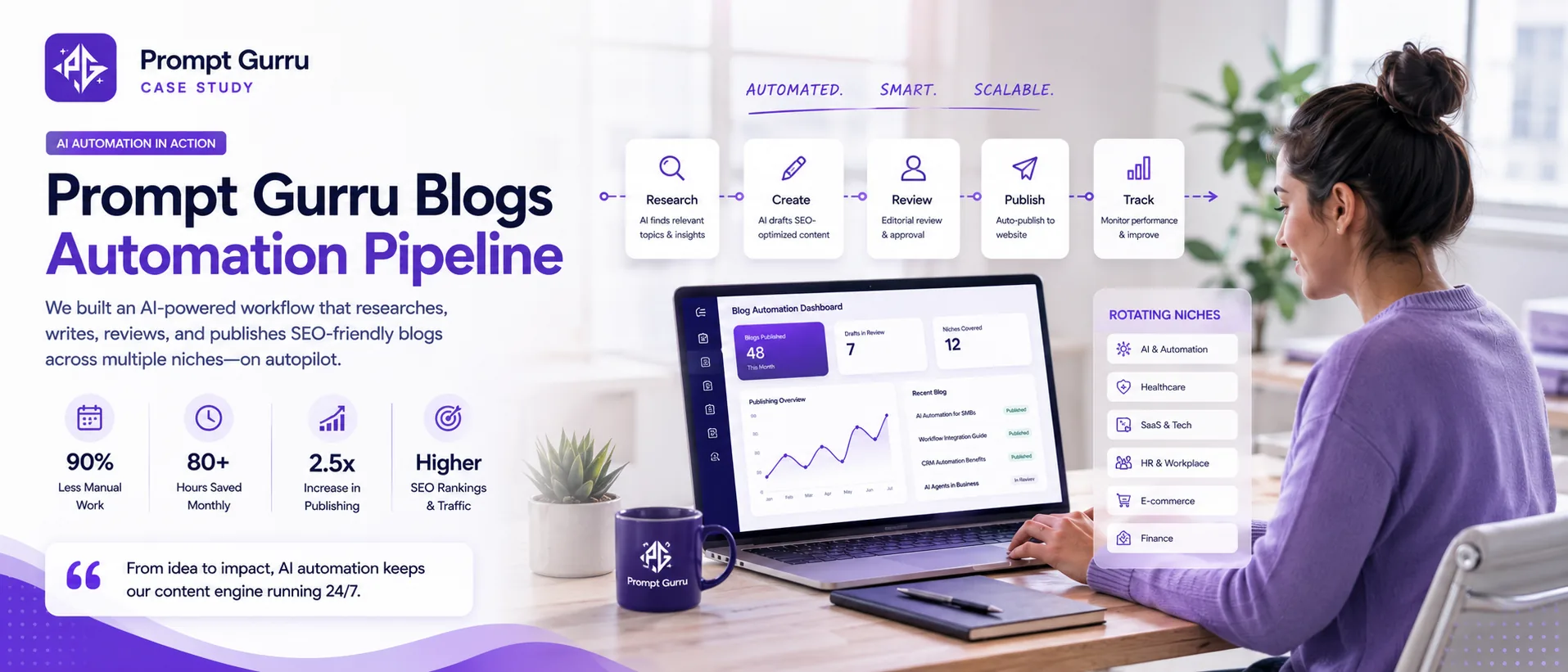
The problem: Before automation, producing high-quality blog content at scale meant juggling multiple writers, editors, and manual scheduling tools. This led to bottlenecks, inconsistent publishing, and missed opportunities for SEO and lead generation. Teams needed a way to automate not just the posting, but also the research, topic rotation, and portfolio integration—without losing the human touch in editorial decisions.
The solution: Prompt Gurru engineered a custom AI workflow using a combination of n8n for orchestration, OpenAI for content generation, and internal editorial logic to ensure every post met specific quality and portfolio criteria. The workflow automatically:
- Rotates through a catalog of business niches and portfolio anchors
- Pulls in relevant research from trusted sources like Microsoft 365 Copilot release notes and Coworker AI's workflow automation best practices
- Generates draft posts with embedded case studies and internal links
- Flags posts for editorial review before scheduling
- Publishes to the live site and updates the portfolio automatically
This approach mirrors trends seen in the latest workflow automation startups, where AI agents and managed runtimes are used to coordinate complex, cross-platform tasks.
Results (illustrative example): With this automated pipeline, Prompt Gurru increased publishing consistency, reduced manual workload, and improved SEO performance by ensuring every article was both timely and anchored in real client work. The system's modular design allows for easy updates as new portfolio projects launch or editorial priorities shift. This case shows how custom AI automation can turn a content bottleneck into a scalable, strategic asset for business growth.
To see more about this project and others, visit our Prompt Gurru Blogs portfolio. If you're ready to automate your own workflows or content operations, book a discovery call with our team.
Best Practices and Common Pitfalls in AI Workflow Automation
Getting AI automation and workflow integration right can be the difference between a streamlined operation and a pile of technical debt. For SMEs and startups, the stakes are high: limited resources mean you need your automation projects to deliver real value, not just technical novelty. Here are the best practices Prompt Gurru recommends, plus common pitfalls to avoid.
- Define a clear scope and business goal. Before building anything, clarify what you want to automate and why. Is it lead qualification, document processing, or internal ticket routing? A focused scope helps avoid feature creep and keeps your AI workflows aligned with business priorities.
- Start small and iterate. Launch with a minimum viable workflow, then expand based on real user feedback. This approach reduces risk and helps you spot issues early. Many successful automation startups, including those profiled by Y Combinator, use this model to validate value before scaling.
- Test iteratively and monitor outcomes. Automated workflows can break in unexpected ways. Build in checkpoints and alerts, and review logs regularly. According to Microsoft Copilot release notes, even mature AI integrations require ongoing monitoring to ensure prompt scheduling and timely responses.
- Plan for maintenance and updates. AI models and APIs change fast. Budget time for regular reviews, prompt updates, and retraining if your workflow depends on external data or LLMs. Neglecting this leads to silent failures or outdated automations.
- Document everything. Keep a clear record of workflow logic, API keys, and integration points. This is essential for onboarding new team members and troubleshooting issues later.
Common Pitfalls to Avoid
- Over-automation: Not every manual step should be automated. Automating rarely used or highly variable processes can waste time and create more problems than it solves. Focus on high-volume, repeatable tasks first.
- Ignoring user feedback: Users are the first to spot friction or errors. If you skip feedback loops, you risk building workflows that look good on paper but fail in practice. Build in ways for users to flag issues and suggest improvements.
- Neglecting security and access controls: Automations often touch sensitive data. Always review permissions and audit logs, especially when integrating with third-party APIs or handling customer information.
- Not planning for scale: Early success can lead to bottlenecks if your workflow can't handle increased volume. Design with growth in mind, using modular tools like n8n or similar open-source orchestrators recommended by Coworker AI for maintainability.
For a practical approach to identifying what to automate first, see our workflow audit guide for SMBs. Following these best practices will help you get more value from your AI automation investment and avoid the most common traps.
DIY vs Hiring Prompt Gurru: Making the Right Choice for Your Business
Choosing between building your own AI automation and workflow integration in-house or partnering with Prompt Gurru is a critical decision for operations leaders and product owners. Each path offers distinct advantages and risks, and the right answer depends on your technical resources, timeline, and appetite for complexity.
DIY AI automation appeals to teams with strong internal engineering and a willingness to experiment. You maintain full control and can tailor every aspect of your workflow automation services. However, DIY comes with hidden costs: ramp-up time, technical debt, and the risk of stalled projects if your team lacks deep experience in prompt engineering, API integrations, or scaling AI workflows. As noted in Coworker AI's review of workflow automation tools, even open-source solutions require disciplined engineering and ongoing maintenance to deliver reliable business process automation.
Hiring Prompt Gurru gives you immediate access to proven expertise in custom AI workflows, workflow automation services, and enterprise AI integration. Our team has delivered production-grade solutions for startups and SMEs, helping clients avoid common pitfalls and accelerate time to value. With Prompt Gurru, you benefit from:
- Faster deployment and reduced trial-and-error
- Custom AI automation tailored to your business processes
- Seamless integration with your existing systems and data
- Ongoing support, clear documentation, and staff training
While DIY might look less expensive at first, the true cost often includes lost productivity, missed deadlines, and the burden of maintaining evolving AI workflows. According to recent trends in workflow automation startups, companies that partner with experienced automation studios typically see faster ROI and fewer operational headaches.
Bottom line: If you have a mature technical team and time to experiment, DIY may be viable. But for most organizations seeking reliable, scalable AI automation and workflow integration, hiring Prompt Gurru is the safer and faster route. Ready to explore your options? Contact Prompt Gurru or book a free discovery call to discuss your project.
Integrating AI Automation with Existing Systems: Challenges and Solutions
Integrating AI automation and workflow automation services into established business environments is rarely straightforward. Operations leaders often run into three main obstacles: data silos, legacy infrastructure, and security or compliance requirements. These issues can slow down or even block the adoption of custom AI workflows if not handled with a solid technical plan.
Data silos are a persistent challenge—when information is trapped in disconnected tools or departments, AI automation and workflow integration can’t deliver full value. Many legacy systems, including older ERPs or custom-built databases, lack modern APIs or up-to-date documentation, making integration time-consuming and risky. Security and compliance add another layer: automating business process automation for sensitive workflows means you need strong access controls, encrypted data flows, and audit trails from day one.
Prompt Gurru addresses these challenges with a proven, step-by-step approach. We start with a discovery phase to map your current tech stack, identify integration bottlenecks, and clarify business priorities. Our team uses API-first design, secure middleware, and modular workflow automation platforms to connect new AI capabilities with your existing systems. For complex cases, we recommend open-source orchestrators or agent frameworks that support custom connectors—this bridges legacy apps and modern SaaS without resorting to fragile workarounds. As noted in Coworker AI’s review of workflow automation tools, clean, maintainable integration is key for long-term success.
Security is built into every project. We implement granular permissioning, encrypted data in transit and at rest, and detailed logging to meet IT and compliance standards. Our team also tracks best practices from the broader automation space, such as those highlighted in Microsoft 365 Copilot’s release notes on prompt scheduling and workflow reliability. For more on how AI automation can be embedded in business systems, see our article AI Integration Services: How to Seamlessly Embed AI into Your Business Systems or explore our AI automation services.
Future-Proofing Your Business with Scalable AI Workflows
Scalability and adaptability are non-negotiable for any business investing in AI automation and workflow integration. As your operations grow, so do your automation requirements—new data sources, changing customer journeys, and evolving compliance needs all put pressure on your existing systems. Rigid, hard-coded workflows can quickly become blockers to growth. That’s why Prompt Gurru builds every custom AI workflow with future-proofing at the core.
Our approach centers on modular, well-documented, and maintainable automation. This means you can add new integrations, update logic, or shift priorities without re-engineering your entire stack. We draw on best practices from the latest open-source orchestration platforms and AI agent frameworks—see how maintainability and prompt engineering are highlighted in this Coworker AI review. Our team also tracks advances in enterprise automation, such as the workflow agent models emerging from Y Combinator-backed startups and the integration capabilities in Microsoft 365 Copilot.
By focusing on scalable design, Prompt Gurru ensures your automation investment keeps pace with your business goals. Whether you’re adding new business units, integrating with more SaaS tools, or responding to market shifts, your workflows will adapt—not hold you back. Our workflow automation services are built for continuous improvement, so you’re always ready for what’s next.
Tip: Don’t just automate for today’s needs. Work with a partner who helps you map out a roadmap for ongoing evolution. Ready to future-proof your operations? Book a discovery call with Prompt Gurru and let’s plan your next step.
FAQs: Common Questions About AI Automation and Workflow Integration
What is the typical cost of AI automation services?
AI automation and workflow integration costs can vary widely based on project scope, number of integrations, and complexity. For a typical small to mid-sized business, custom workflow automation projects with Prompt Gurru often start in the $8,000 to $25,000 range (illustrative US market bands), covering discovery, build, testing, and team training. More advanced solutions with AI agents, legacy system integration, or custom UI can increase the investment. For a tailored estimate, contact Prompt Gurru for a discovery call.
How long does it take to implement workflow integration?
Implementation timelines depend on the number of workflows, data sources, and required integrations. Simple automations can be delivered in 3 to 6 weeks, while more complex projects may take 8 to 16 weeks. Prompt Gurru uses an agile approach to deliver value early and adapt as requirements evolve. For more on project scoping, see our article When to Hire a Custom Software Developer vs Buying SaaS Tools.
Can Prompt Gurru integrate AI with legacy systems?
Yes. Prompt Gurru specializes in connecting modern AI automation with legacy ERPs, databases, and on-premise tools. We use secure APIs, middleware, and custom connectors to bridge old and new systems—similar to how leading workflow automation startups are enabling AI agents to interact with supply chain and back-office platforms (see industry examples).
When should I hire Prompt Gurru versus building in-house?
If your team lacks deep experience with AI workflow automation, or if you need to move quickly and avoid costly trial-and-error, hiring Prompt Gurru makes sense. We bring proven frameworks, reusable modules, and hands-on integration expertise—reducing risk and accelerating delivery. For teams with strong internal dev capacity and simple needs, DIY can work, but most businesses benefit from a specialist partner for anything beyond basic automations.
What business processes benefit most from AI automation?
AI automation delivers the biggest impact in repetitive, rules-based, or data-heavy processes—think lead qualification, customer support, invoice processing, reporting, and cross-system data sync. According to industry guides (see workflow automation best practices), clean prompt engineering and workflow design are key to reliable results. If you want to explore automation opportunities in your business, book a free discovery call with Prompt Gurru.
About the author
Prompt Gurru is a practitioner-led software studio specializing in AI automation, workflow integration, and custom digital products for startups and SMEs. With over 5 years of experience and more than 50 shipped projects, our team has delivered solutions across mobile SaaS, marketplaces, HRM, education, wellness, and advanced AI workflows.
Our portfolio features live products such as Max Invoice (invoicing automation), Max HR (workforce management), Mindway (EAP/wellness), Makflip (marketplace platform), and Prompt Gurru Blogs (AI-driven content automation). Our expertise covers n8n workflow orchestration, OpenAI API integrations, chatbots, CRM automation, and cross-platform app development.
We serve clients in 25+ countries and are trusted by founders at Max ERP, Mindway, Zeebrix, and Wahy Institute. If you are exploring AI automation or custom workflow integration for your business, contact us or book a free discovery call to discuss your goals.
Ready to automate your business?
We build n8n workflows, AI pipelines, Flutter apps, and custom software for startups and SMEs - like the system that powers this blog.
Book a free discovery call