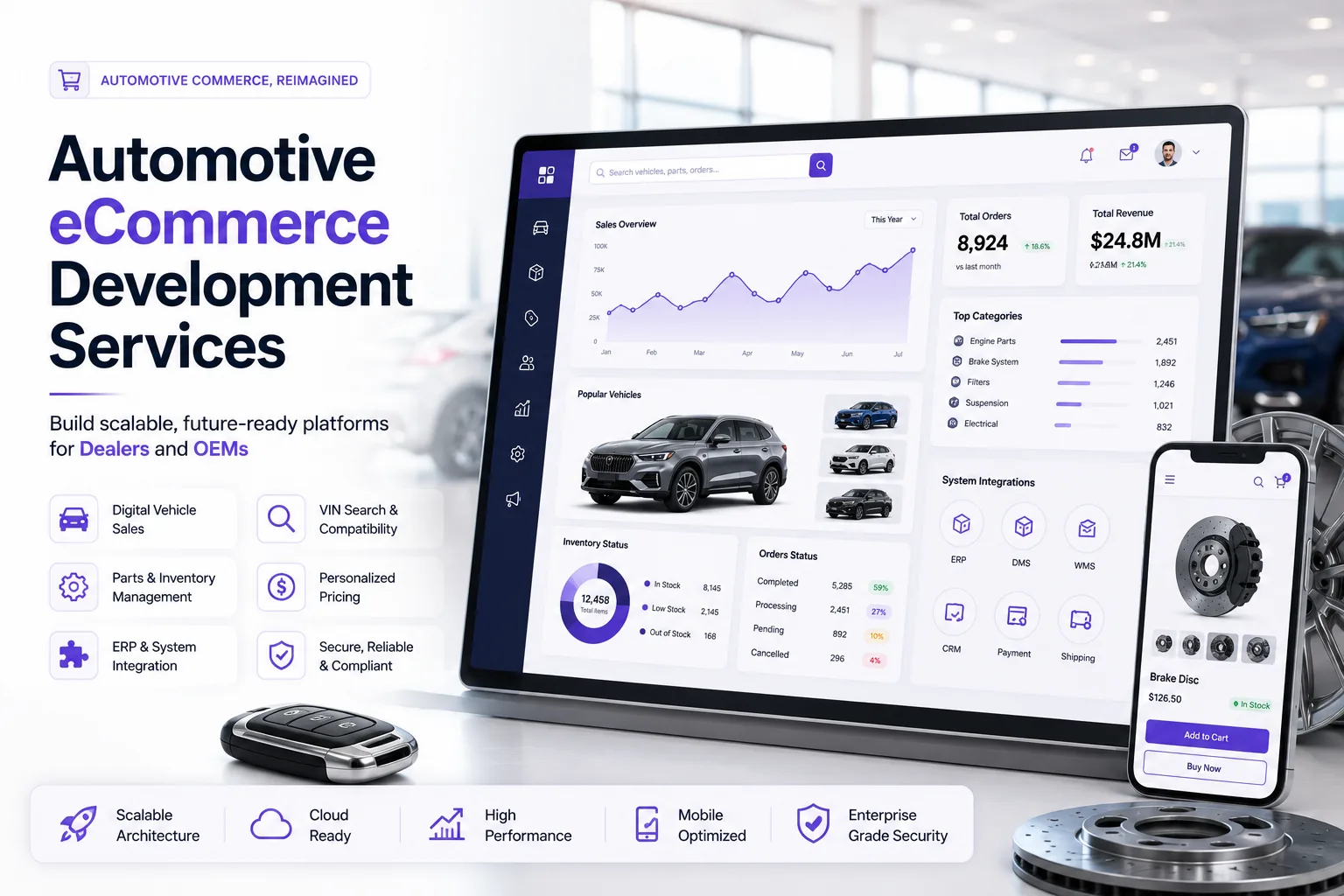
Discover how to develop and scale custom automotive eCommerce platforms tailored for dealers and OEMs. This guide covers essential features, integration options like ERP and VIN search, and real-world case studies to help you choose the right development approach.
Introduction: Why Automotive eCommerce Development Matters Now
If you are a founder, product owner, or operations lead at a dealership, OEM, or automotive parts supplier, the pressure to modernize your sales channels is real. Automotive eCommerce Development Services are no longer a nice-to-have—they are essential for staying relevant as buyers expect to research, compare, and purchase vehicles and parts online. Traditional sales models are losing ground to digital-first competitors, and generic eCommerce platforms rarely address the unique needs of the automotive sector.
Today’s automotive eCommerce platforms must support complex requirements: VIN search, real-time inventory, B2B pricing, ERP integration, and compliance, all while delivering a frictionless customer experience. Whether you are planning a full-featured vehicle sales eCommerce site, an automotive parts online store, or a B2B automotive portal, the right technology stack and integrations will determine your success. According to industry experts, demand for custom solutions has surged as dealerships and OEMs seek scalable, future-proof platforms tailored to their workflows.
Missed integrations or clunky workflows can cost you sales and frustrate both staff and customers. On the other hand, a well-built aftermarket automotive eCommerce platform or dealer portal can unlock new revenue streams and streamline operations. For a practical look at how to scope, build, and scale these platforms, this guide breaks down the features, integrations, and technical choices that matter most. If you are weighing the tradeoffs of building in-house versus hiring a specialist, or want to compare custom builds with off-the-shelf tools, you are in the right place.
For more on eCommerce platform development and retail solutions, see our Ecommerce Software Development & Retail Solutions article. To discuss your automotive eCommerce project, visit our services page.
Key Features of Automotive eCommerce Platforms
For founders and product owners in the automotive sector, building a successful automotive eCommerce platform means more than just listing vehicles or parts online. The right features can directly impact sales velocity, operational efficiency, and customer trust. Here are the essential components every modern automotive eCommerce solution should include:
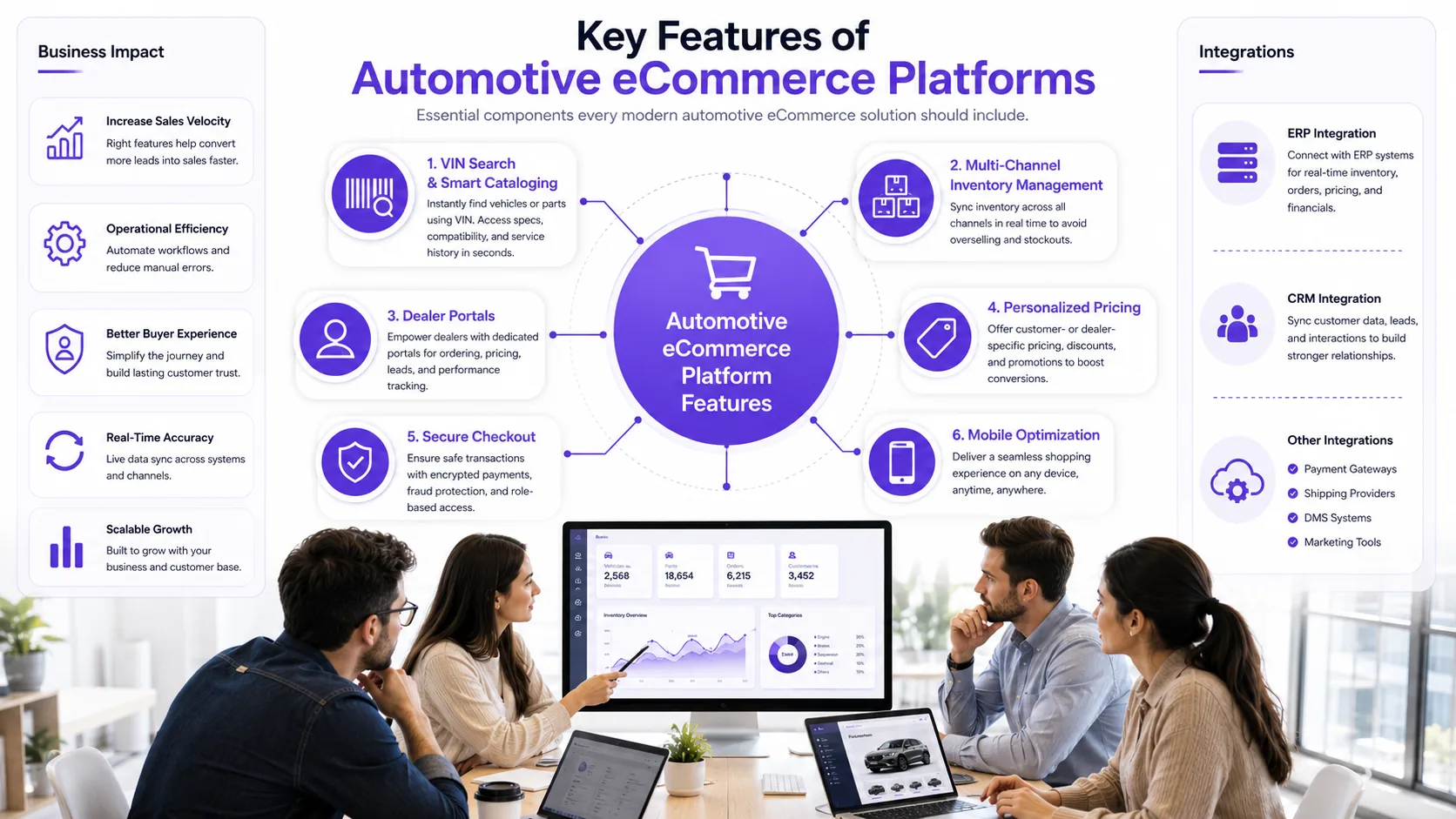
- VIN Search and Smart Cataloging: Integrating VIN (Vehicle Identification Number) search lets customers instantly pull up detailed specs, compatible parts, and service histories. This not only streamlines the buying process for vehicles and automotive parts online stores, but also reduces errors in part selection and increases buyer confidence. According to Folio3, VIN search is now a baseline expectation for both dealers and B2B automotive portals.
- Multi-Channel Inventory Management: Automotive eCommerce platforms must sync inventory across dealer lots, warehouses, and online storefronts. Real-time inventory visibility prevents overselling and supports both B2C and B2B workflows. Many platforms now offer integrations with ERP systems to automate updates and reporting. For a practical overview of project planning and inventory sync, see this eCommerce project guide.
- Dealer and Supplier Portals: Secure portals for dealers, OEMs, and suppliers allow for bulk uploads, price management, and order tracking. These portals are especially important for B2B automotive portals and aftermarket automotive eCommerce, where large catalogs and negotiated pricing are the norm. Role-based access ensures sensitive data is only visible to authorized users.
- Personalized Pricing and Promotions: Automotive eCommerce is rarely one-size-fits-all. Platforms should support dynamic pricing based on user type (retail, wholesale), location, or negotiated contracts. Personalized offers and loyalty programs can be managed directly in the admin panel, helping dealers and suppliers run targeted campaigns.
- Secure Checkout and Financing Options: A frictionless, secure checkout is critical for both vehicle sales eCommerce and parts distribution. Support for multiple payment gateways, financing calculators, and digital contract signing builds trust and reduces cart abandonment. Leading platforms also integrate with third-party financing providers and insurance APIs for a complete transaction experience.
- Mobile-Optimized Experience: Buyers now expect to browse and purchase vehicles or parts from any device. Responsive design, fast load times, and mobile-friendly search/filtering are must-haves for capturing leads and closing sales on the go.
These features are not just technical checkboxes—they are directly tied to business outcomes like higher conversion rates, lower operational costs, and improved dealer-customer relationships. For more on automating lead follow-up and integrating CRM workflows, see our post on how to automate lead follow-up emails with n8n and your CRM. You can also review our guide to eCommerce software development for retail for broader platform patterns. To see how these features come together in shipped projects, browse our portfolio case studies for automotive and eCommerce builds.
For a deeper dive into how these features support specialized use cases like vehicle sales and aftermarket parts, continue to the next section or explore external resources such as this blueprint on automotive eCommerce platform development.
Specialized Use Cases: Vehicle Sales, Parts Distribution, and Aftermarket Services
Automotive eCommerce platforms are not one-size-fits-all. The right solution depends on whether you're selling vehicles, automotive parts, or aftermarket services. Each use case brings unique requirements for user experience, integrations, and business workflows.
Vehicle Sales eCommerce: Platforms designed for new or used vehicle sales must support complex product data, VIN-based search, finance calculators, and trade-in workflows. Dealer portals often require inventory sync with DMS/ERP systems and tools for digital paperwork. For example, a dealership group might need multi-location inventory management and dynamic pricing. According to Appinventiv's guide, vehicle sales platforms frequently integrate lead capture, appointment booking, and digital contract signing to streamline the buyer journey.
Automotive Parts Online Stores: Selling parts and accessories online demands robust catalog management, fitment lookup (by VIN or model), and real-time inventory updates. B2B automotive portals for wholesalers or repair shops often include bulk ordering, tiered pricing, and integration with supplier ERPs. This setup helps reduce manual order processing and improves accuracy. As noted by Folio3, parts stores benefit from advanced search, compatibility filters, and automated reordering features.
Aftermarket Automotive eCommerce: Platforms for aftermarket services—such as maintenance packages, extended warranties, or custom upgrades—focus on bundling, subscription management, and service scheduling. These solutions may integrate with workshop management tools and customer CRMs. For B2B buyers, portals can enable contract-based pricing and recurring billing, supporting long-term relationships with fleets or service partners.
Choosing the right platform architecture and feature set is critical for operational efficiency and customer satisfaction. If you're weighing whether to build custom or adapt off-the-shelf tools, see our analysis in When to Hire a Custom Software Developer vs Buying SaaS Tools. For more examples of shipped automotive and eCommerce builds, visit our Portfolio case studies.
Integrations: ERP, VIN Search, and B2B Portals
For any serious automotive eCommerce platform, integrations are not just a nice-to-have—they are the backbone of efficient operations and customer experience. Whether you are building for a dealership, OEM, or aftermarket supplier, your platform's ability to connect with ERP systems, VIN search providers, and B2B automotive portals will shape how well you scale and serve your customers.
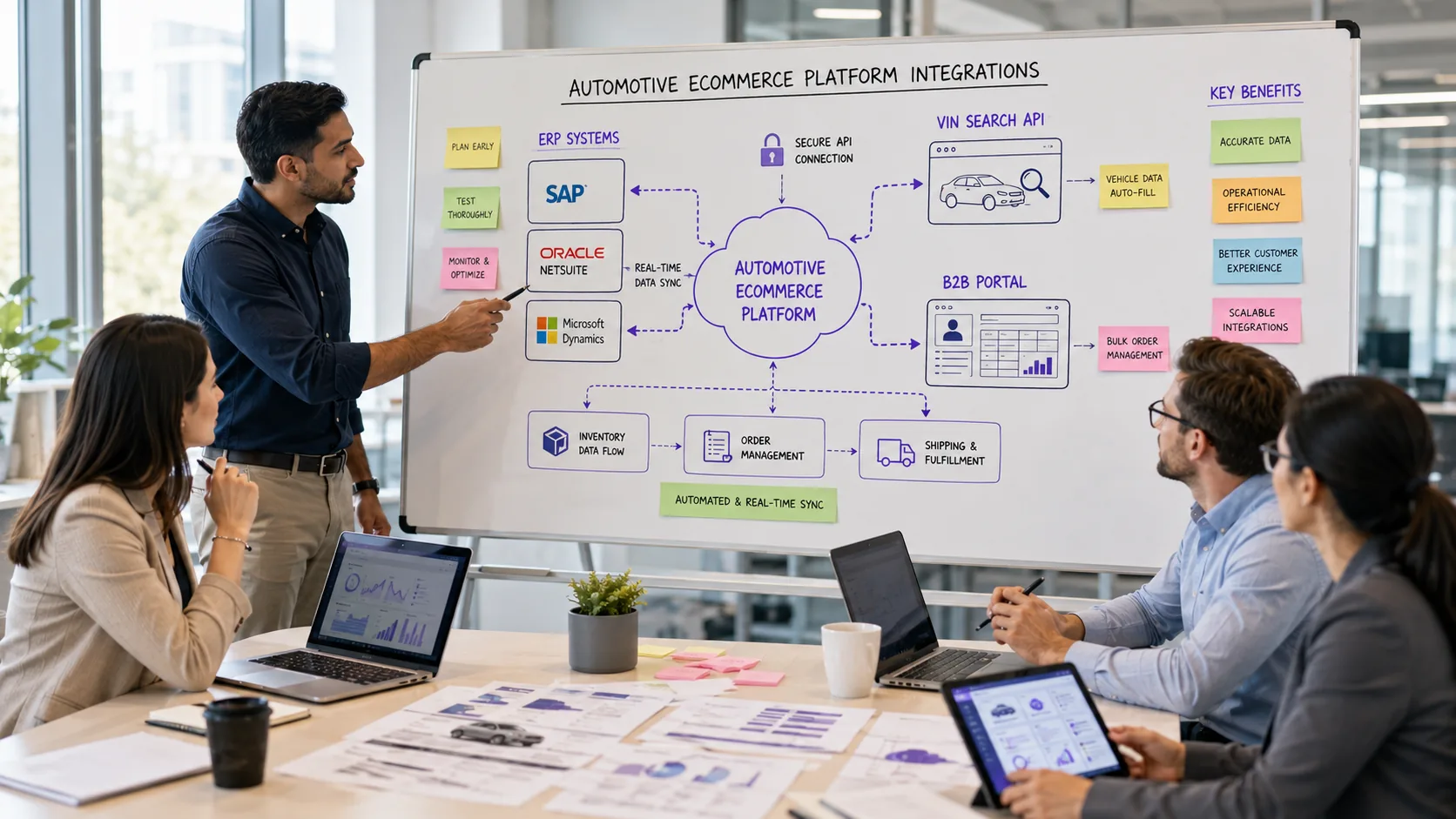
ERP integration automotive is essential for real-time inventory, pricing, and order management. Platforms like SAP, Oracle NetSuite, and Microsoft Dynamics are common choices in the automotive sector. When your eCommerce site syncs with your ERP, you avoid double entry, reduce errors, and ensure that customers always see accurate stock and delivery timelines. However, ERP integration can be complex—especially if you have legacy systems or highly customized workflows. It's critical to scope these integrations early and test thoroughly.
VIN search and decoding services are another must-have for vehicle sales eCommerce. By integrating with providers like Experian, VinAudit, or NHTSA APIs, your platform can auto-populate vehicle specs, validate listings, and help buyers find the exact models or parts they need. This not only streamlines the listing process but also builds trust with buyers who expect precise, up-to-date data. For a deeper dive into how these integrations fit into the broader platform, see the Automotive eCommerce Development Services guide.
Finally, B2B automotive portals are vital for wholesalers and suppliers managing dealer networks. Integrating with B2B portals allows for bulk ordering, tiered pricing, and custom account management. These integrations often require secure API connections and role-based access controls to protect sensitive pricing and inventory data. As highlighted in this industry blueprint, robust B2B features are now expected by both large and mid-sized automotive players.
When planning your automotive eCommerce build, prioritize integrations that automate manual work, support your sales channels, and future-proof your workflows. For more on platform architecture and integration best practices, check out our Ecommerce Software Development & Retail Solutions post or explore our development services.
Technical Architecture: Headless Commerce and Microservices for Scalability
For automotive eCommerce platforms, the right technical architecture is what separates a scalable, future-proof solution from a brittle, hard-to-maintain site. Two modern approaches stand out: headless commerce and microservices. Both are increasingly favored by automotive dealerships, OEMs, and B2B parts suppliers looking to support complex catalogs, real-time inventory, and seamless integrations.
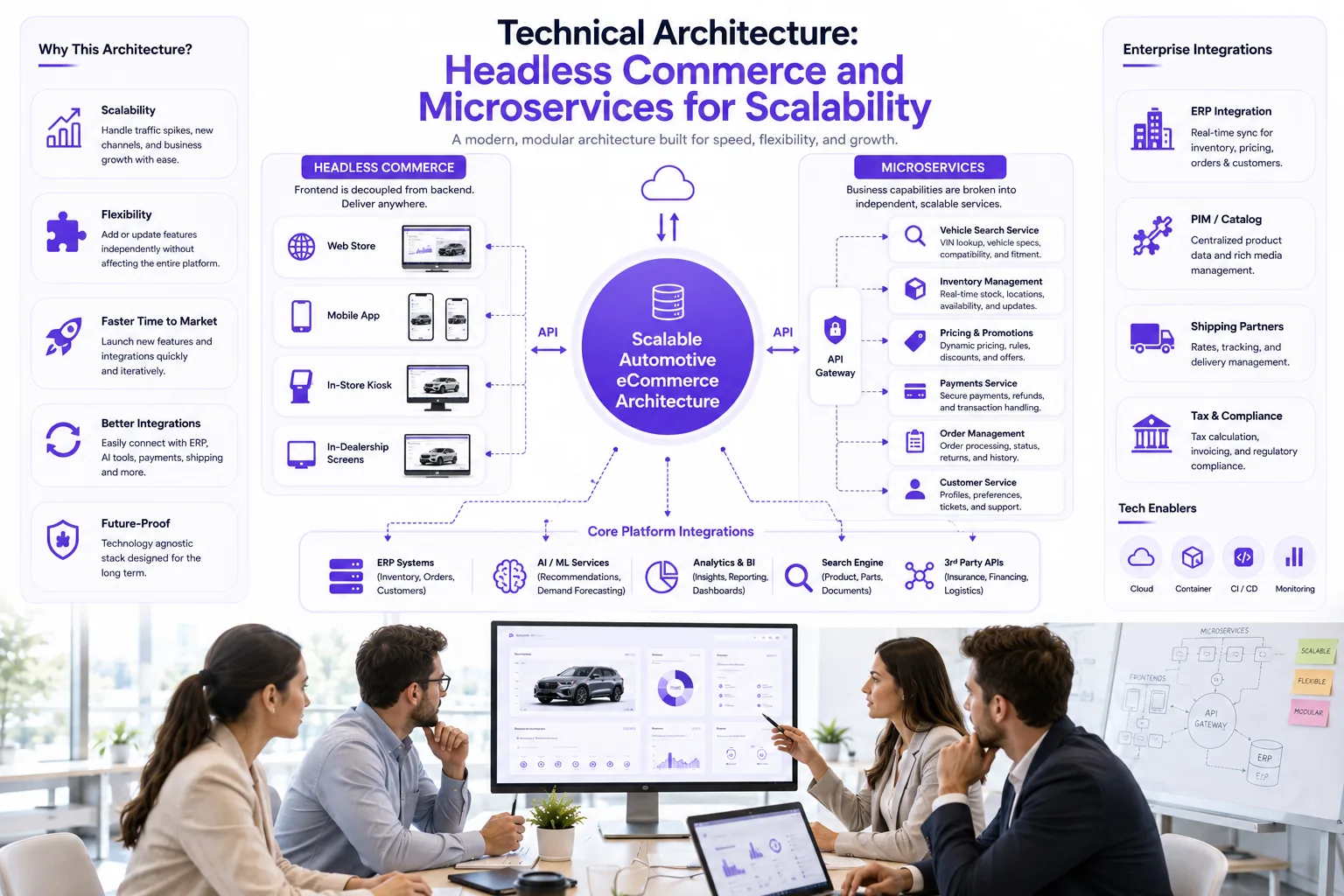
Headless commerce means decoupling the frontend (what your customers see) from the backend (where your business logic and data live). This lets you deliver rich, branded experiences across web, mobile, kiosks, and even in-dealership screens—all powered by the same backend APIs. For example, a dealership can launch a mobile app for vehicle browsing and a separate B2B portal for fleet buyers, both drawing from a unified product and inventory system. According to SPXCommerce, headless platforms also make it easier to integrate with modern frontend frameworks and third-party services.
Microservices architecture breaks your platform into small, independent services—like vehicle search, VIN decoding, order management, and payment processing. Each service can be developed, deployed, and scaled separately. This is especially valuable in automotive eCommerce, where you might need to update the parts catalog without risking downtime for vehicle sales. Microservices also reduce vendor lock-in and make it easier to swap out components as your needs evolve. Industry guides such as Folio3 highlight the importance of modularity for integrating ERP, CRM, and logistics partners.
In practice, a scalable automotive eCommerce platform often combines both patterns: a headless backend exposing APIs, with microservices handling specialized functions. This approach supports rapid feature rollout, easier maintenance, and integration with AI-driven tools for pricing or inventory (see Vrinsofts for more on AI in automotive). For a deeper dive into how these architectures fit into broader digital product builds, see our Web Application Development and Workflow Automation for AI and Business Teams in 2026 guide.
Choosing the right architecture depends on your current systems, integration needs, and growth plans. If you want to discuss which model fits your dealership or parts business, contact our team for a technical discovery call.
Portfolio Case Study: Illustrative Example from Automotive eCommerce Development
When it comes to building scalable automotive eCommerce platforms, decision-makers want proof that custom solutions can deliver real business value. The holo project, developed by Prompt Gurru, is an illustrative example that demonstrates how a modern architecture and deep automotive integrations can support both dealer operations and OEM requirements. See more in our portfolio.
Business context: holo set out to unify ride booking and hotel stays, but its core eCommerce engine was designed for extensibility—making it directly relevant to automotive retail, B2B parts sales, and aftermarket services. The platform needed to handle complex inventory (vehicles, parts, and services), dynamic pricing, and multi-role access for dealers, OEMs, and end customers.
Technical approach: The holo stack used a headless commerce model with a microservices backend, allowing rapid deployment of new sales channels and integrations. Dealer admins could manage vehicle listings, parts catalogs, and promotions through a unified dashboard. VIN search and ERP sync were implemented via modular APIs, making it easy to connect with dealer management systems and external B2B portals. This mirrors best practices described in industry guides such as Appinventiv's automotive eCommerce platform blueprint and Folio3's integration-focused approach.
Outcomes and lessons: By separating the frontend from the backend, holo enabled flexible UI updates and multi-brand deployments without disrupting core commerce logic. The modular integration layer reduced onboarding time for new dealer partners and simplified compliance with OEM data standards. For automotive eCommerce buyers, this approach means faster go-to-market and lower long-term maintenance costs compared to monolithic builds. For more on project planning and documentation, see Elogic's eCommerce project guide.
If you're considering a custom automotive eCommerce build, review our portfolio case studies or book a discovery call to discuss your requirements.
DIY vs Hiring a Development Partner: Tradeoffs and Considerations
Choosing between building your automotive eCommerce platform in-house or hiring a specialized development partner is a pivotal decision for dealerships, OEMs, and parts suppliers. The right path depends on your internal resources, project complexity, and long-term goals.
Cost and Timeline: DIY development can appear cost-effective if you already have a skilled technical team, but hidden costs often emerge. Recruiting or upskilling developers, managing integrations (like ERP or VIN search), and maintaining security standards all add to the total cost of ownership. Projects can also drag out for months if your team is learning as they go. In contrast, hiring an experienced partner typically means a higher upfront investment, but you benefit from proven workflows, faster delivery, and fewer missteps. As highlighted in this practical guide, outsourcing brings structured project planning and clear deliverables.
Expertise and Scalability: Automotive eCommerce platforms demand deep knowledge of industry-specific features—think B2B portals, parts catalogs, and compliance needs. Without prior experience, in-house teams risk missing critical requirements or building brittle systems. Specialized partners bring reusable modules, integration experience, and best practices from similar projects. According to Folio3's overview, expert teams can accelerate ERP integration and custom workflows, reducing rework and technical debt.
Ongoing Support: Post-launch, DIY teams must handle bug fixes, upgrades, and feature requests on top of daily operations. A development partner usually offers support contracts and can scale resources up or down as your business evolves.
For most automotive businesses, the DIY route only makes sense if you have a mature, cross-functional tech team and a simple project scope. If your goal is to launch a scalable, future-proof platform with complex integrations, hiring a partner is usually the safer and faster bet. For more on this decision, see our article When to Hire a Custom Software Developer vs Buying SaaS Tools.
Ready to discuss your project or need a second opinion? Contact Prompt Gurru for a discovery call and see how our team can help you build or scale your automotive eCommerce platform.
Common Challenges and Best Practices in Automotive eCommerce Development
Building and scaling automotive eCommerce platforms comes with a unique set of challenges. The most frequent pain points we see are integration complexity, data accuracy, user experience for dealer staff, and compliance with regional regulations.
Integration complexity is often the biggest hurdle. Automotive eCommerce solutions rarely stand alone—they must connect with dealer management systems, ERP software, VIN lookup tools, inventory feeds, and payment gateways. If APIs are poorly documented or data formats are inconsistent, integration work can drag out and introduce costly errors. To avoid this, prioritize platforms with clear, well-supported APIs and allocate extra time for integration testing. For a practical breakdown of integration patterns, see Folio3's automotive eCommerce guide.
Data accuracy is another critical risk. Vehicle listings, parts catalogs, and pricing must be kept current across all channels. Automating data syncs and building validation checks into your workflow can prevent expensive mistakes. As highlighted in Appinventiv's platform development blueprint, mapping your data model early and understanding all source systems is essential to avoid downstream issues.
User experience (UX) for dealer staff and buyers is often underestimated. Many users are not tech experts, so interfaces must be intuitive, mobile-friendly, and support quick VIN or part number lookups. Regular usability testing with real dealership users will help surface friction points before launch.
Compliance and security should never be an afterthought. Regional rules for data privacy, payments, and digital contracts can vary widely. Work with legal advisors to ensure your platform meets all requirements, and document your compliance process as part of your project plan—see Elogic's project planning guide for a checklist approach.
Best practices that consistently deliver results include: scoping integrations up front, automating data validation, designing for non-technical users, and embedding compliance reviews into every sprint. If your team is new to automotive eCommerce, partnering with a studio that has shipped similar platforms can shortcut many of these pitfalls. For more on building and scaling eCommerce solutions, see our Ecommerce Software Development & Retail Solutions post or explore our services.
Pricing and Project Scope Overview
Budgeting for Automotive eCommerce Development Services means understanding both the scope and the factors that drive cost. For a custom automotive eCommerce platform—whether you are a dealership group, OEM, or aftermarket parts supplier—illustrative US market pricing typically ranges from $80,000 to $250,000+ for a full-featured build. This estimate covers the full project lifecycle: discovery and planning, design, core development, integrations (such as ERP, VIN search, and B2B modules), thorough testing, documentation, and team training.
Key cost drivers include the number and complexity of integrations (ERP, inventory, payment gateways), custom workflows for vehicle sales or parts catalogs, and advanced architecture choices like headless commerce or microservices. Projects with multi-tenant dealer portals, B2B procurement, or deep aftermarket modules will trend toward the higher end. According to Folio3 and other industry sources, integrations and ongoing support are often underestimated in initial budgets.
Typical project phases and illustrative US cost bands:
- Discovery & Planning: $10,000 to $25,000 (requirements, architecture, UI/UX design)
- Core Build & Integrations: $50,000 to $160,000 (platform, APIs, ERP/VIN/B2B modules)
- Testing & QA: $8,000 to $20,000 (functional, security, performance)
- Training & Documentation: $5,000 to $15,000 (admin training, user guides)
US agency hourly rates for this work usually range from $100 to $200/hr for boutique teams, and $150 to $250/hr for specialist agencies. These rates typically include project management, code reviews, and a defined post-launch support window. Ongoing costs—such as cloud hosting, API usage, and maintenance retainers—should be factored into your total cost of ownership. For a practical breakdown of eCommerce project planning, see this step-by-step guide.
Every project is unique. If you need a tailored estimate or want to discuss your specific requirements, explore our services or book a discovery call with Prompt Gurru.
FAQs: Automotive eCommerce Development Services
What is the typical cost of automotive eCommerce development?
Custom automotive eCommerce platforms usually start at $60,000 to $150,000 USD for a scoped MVP, with full-featured builds for large dealerships or OEMs ranging higher. Costs depend on features like VIN search, ERP integration, and B2B portals. For a breakdown of build vs buy tradeoffs, see our guide to hiring custom software vs buying SaaS. Always request a detailed estimate based on your workflow and integration needs.
How long does it take to build a custom automotive platform?
Most projects take 4 to 8 months from discovery to launch, depending on complexity, integrations, and data migration. Fast-track MVPs for parts stores or single-dealer setups can sometimes go live in 10 to 16 weeks. A clear project plan, like those outlined in this practical guide, helps avoid delays.
What are essential integrations for automotive eCommerce?
Key integrations include ERP systems for inventory and order sync, VIN lookup for vehicle data, payment gateways, shipping APIs, and B2B dealer portals. For parts and aftermarket, catalog management and fitment data are critical. See more integration options at Folio3's automotive eCommerce guide.
Should we hire a development partner or build in-house?
If your team lacks deep experience in automotive eCommerce, hiring a specialist partner saves time and reduces risk. In-house teams work well for ongoing maintenance if you already have strong technical staff. For most dealerships and OEMs, a hybrid approach—partner for the initial build, then train your team—delivers the best results. Contact us for a discovery call to discuss your scenario.
What features are critical for vehicle sales eCommerce?
Must-have features include advanced search by make/model/VIN, real-time inventory, finance calculators, lead capture, trade-in tools, and mobile-friendly design. For B2B and aftermarket, add bulk ordering and account management. For a detailed feature list, see this automotive eCommerce platform overview.
About the author
Prompt Gurru is a specialist software studio with over 10 years of experience delivering AI automation, custom web and mobile apps, and eCommerce platforms for startups and SMEs worldwide. Our team has shipped 50+ projects across automotive, eCommerce, HRM, and marketplace domains, including live products like Makflip, SellerZone, and Max Invoice.
We understand the unique demands of automotive eCommerce development—dealer portals, ERP integrations, VIN search, and scalable B2B features. Our expertise covers everything from technical architecture to end-to-end delivery, helping founders and product owners build platforms that grow with their business.
To discuss your automotive eCommerce project or get a tailored quote, contact Prompt Gurru or book a free discovery call.
Ready to automate your business?
We build n8n workflows, AI pipelines, Flutter apps, and custom software for startups and SMEs - like the system that powers this blog.
Book a free discovery call