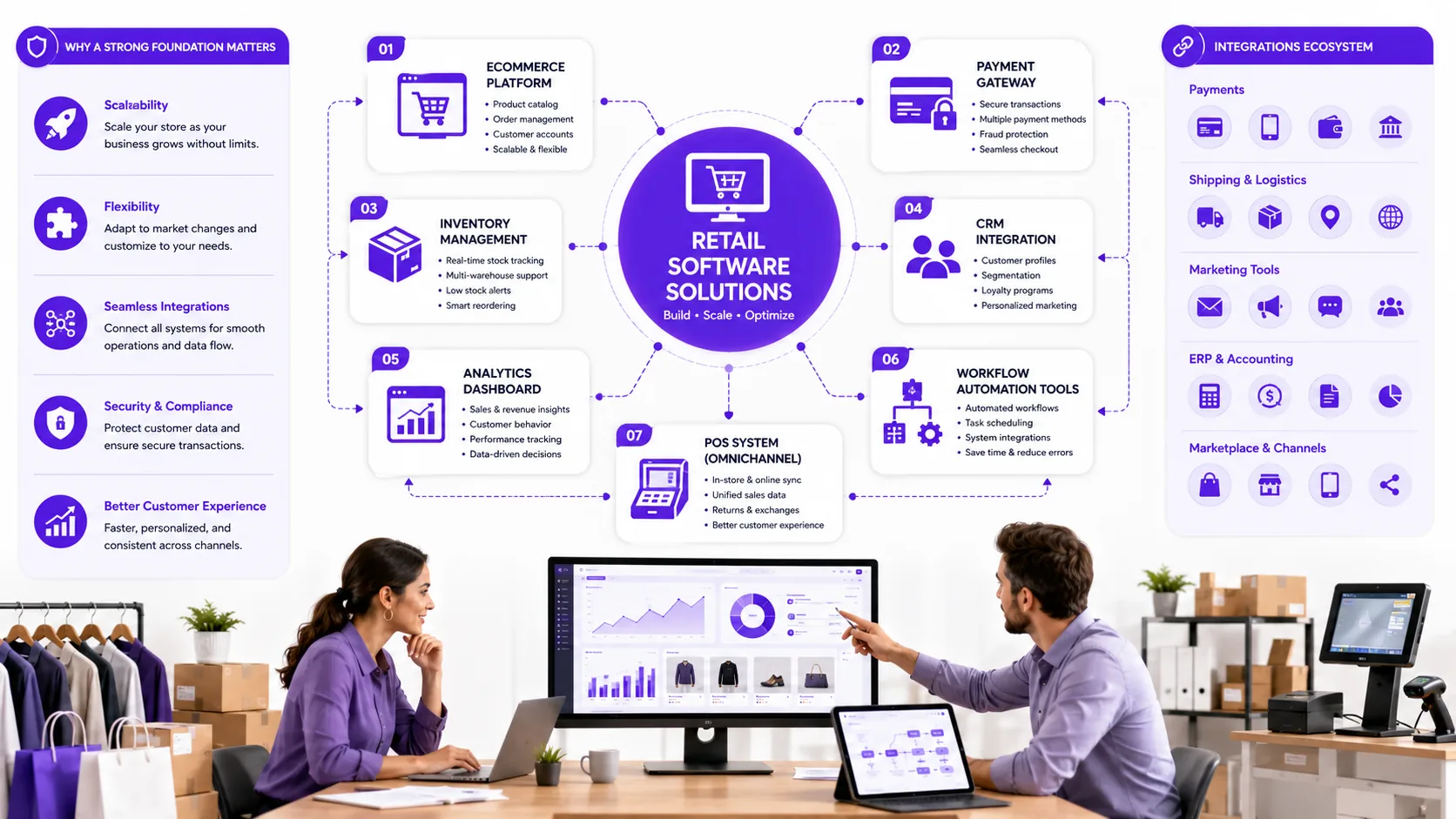
Learn how to plan, build, and scale ecommerce software and retail solutions with proven tools, workflows, and real-world case studies. This guide helps ecommerce founders and retail ops managers confidently decide between custom builds and SaaS platforms to optimize their online stores.
Why Ecommerce Software Development Matters for Retail Success
If you are an ecommerce founder, retail ops manager, or product owner, you already know the stakes: Ecommerce Software Development is now the engine behind retail growth, customer experience, and operational control. The right technology stack is what lets your online store scale, adapt to new channels, and deliver the seamless buying journeys shoppers expect.
Retail and ecommerce are no longer separate worlds. Shoppers move between physical and digital touchpoints, and your business needs to keep up. Off-the-shelf platforms can get you started, but as you grow, gaps emerge—inventory sync headaches, limited integrations, and workflows that do not fit your real processes. That is when decision-makers face the classic build vs buy dilemma: should you invest in custom ecommerce software, or double down on SaaS retail solutions?
Modern retail software is about much more than a shopping cart. It is about integrating order management, payments, inventory, and customer data across every channel. According to Sonatype, retail engineering teams now rely on software that must perform at scale and adapt quickly to market shifts. The right approach—custom build, SaaS, or hybrid—can directly impact your margins, agility, and customer loyalty. For a practical look at how to plan, build, and optimize your ecommerce stack, this guide draws on proven tools, workflows, and shipped platforms like SellerZone and Makflip.
You will learn how to avoid common pitfalls, make a confident build or buy decision, and see what works in the real world. For more examples, see our portfolio case studies or explore our AI automation and ecommerce services.
Understanding Ecommerce Software and Retail Solutions: Key Components and Trends
Building a successful online store or modernizing a retail operation starts with understanding the software ecosystem that powers ecommerce today. At its core, ecommerce software development covers a spectrum of solutions: from online store platforms and point-of-sale (POS) systems to inventory management, order processing, and customer experience tools. Choosing the right mix is critical for founders and retail ops managers aiming to scale efficiently and adapt to changing buyer expectations.
Most ecommerce stacks start with a platform—think Shopify, Magento, or a custom build—responsible for product catalogs, shopping carts, and checkout flows. Retail software solutions often add POS integrations, real-time inventory sync, and omnichannel order management, helping teams bridge online and in-store sales. According to Sonatype, high-performing retail engineering teams rely on scalable software that can handle spikes in demand and support rapid feature releases.
One of the biggest shifts in recent years is the move toward composable commerce. Instead of relying on a single monolithic platform, composable commerce lets you assemble best-in-class tools for each business function—such as payments, search, or loyalty—using APIs and microservices. This approach gives retailers more flexibility to swap out components as needs evolve. For a deeper dive, see RBMSoft's guide to composable commerce.
AI and automation are also reshaping the ecommerce landscape. Retailers are adopting AI-driven product recommendations, chatbots, and smart inventory forecasting to improve customer experience and operational efficiency. As highlighted by Retail Solutions, the right AI tools can help platforms scale faster and adapt to market changes with less manual intervention.
Staying current with these trends is essential for anyone planning an ecommerce platform build or retail technology upgrade. For a practical breakdown of platform choices and workflow automation, check our ecommerce development guide or browse Prompt Gurru's portfolio for real-world examples.
Choosing the Right Ecommerce Platform: Custom Build vs SaaS Solutions
One of the biggest decisions for ecommerce founders and retail product owners is whether to build a custom ecommerce platform or use a SaaS (software-as-a-service) solution. The right choice impacts your ability to scale, adapt to new business models, and control costs as you grow. Let's break down the tradeoffs so you can make an informed decision for your next online store or retail tech upgrade.
Custom Ecommerce Software Development gives you total flexibility. You can design workflows, integrations, and customer experiences tailored to your brand and operations. This approach is ideal if you have unique requirements—like multi-vendor marketplaces, complex pricing, or deep integration with legacy retail systems. However, custom builds require a higher upfront investment, a longer launch timeline, and ongoing maintenance. According to eCommerce Development: The Complete Guide for 2026, custom platforms are best suited for businesses with specialized needs or those planning to scale aggressively.
SaaS Ecommerce Platforms (like Shopify, BigCommerce, or Wix) offer speed and predictability. You get a proven foundation, regular updates, and built-in security. SaaS is a strong fit for brands that want to launch quickly, keep IT overhead low, and use standard ecommerce features. The tradeoff is limited customization—you're bound by the platform's feature set and roadmap. As your business grows, you may hit walls on integrations, unique checkout flows, or performance at scale. For many retail teams, SaaS is a great starting point, but custom development becomes attractive as needs outgrow the box.
Scalability and Flexibility are key decision points. If you expect rapid growth, complex inventory, or omnichannel retail, a custom solution can future-proof your stack. As noted by Sonatype's guide to modern retail software, engineering teams often turn to custom builds when SaaS platforms can't keep up with evolving requirements or performance demands.
Cost Considerations go beyond licensing. SaaS platforms have predictable monthly fees, but custom builds involve upfront design, development, and ongoing support. Over several years, total cost of ownership can favor custom if you avoid SaaS overages and unlock operational efficiencies. For a deeper breakdown, see our When to Hire a Custom Software Developer vs Buying SaaS Tools article.
Decision Criteria for founders and product owners:
- Do you need features or workflows that SaaS platforms can't provide?
- Is brand experience or integration with retail systems a top priority?
- Are you planning for rapid scale, multi-channel, or global expansion?
- What is your budget for upfront build vs ongoing SaaS fees?
If your answers lean toward unique requirements, deep integrations, or long-term scale, a custom ecommerce software build is worth exploring. If speed, simplicity, and predictable costs matter most, SaaS is a smart starting point.
Still unsure? Book a discovery call with Prompt Gurru to map your requirements and get practical advice on the best-fit ecommerce platform for your business.
Core Features and Integrations for Modern Retail Software
For ecommerce founders and retail ops managers, choosing the right software features is critical to running a resilient, scalable online store. At a minimum, your ecommerce platform should deliver:
- Inventory Management: Centralized inventory lets you track stock across warehouses, automate low-stock alerts, and sync product data between online and offline channels. This is essential for avoiding overselling and keeping fulfillment smooth. As highlighted in this retail software guide, inventory automation is now a baseline expectation for modern commerce.
- Payment Gateways: Integrating with trusted payment providers (Stripe, PayPal, local gateways) ensures secure, fast transactions and supports multiple currencies. Flexible payment options can boost conversion rates and customer trust.
- Order Tracking: Customers expect real-time order status updates, shipment tracking, and automated notifications. This reduces support tickets and builds loyalty.
- CRM Integration: Connecting your ecommerce platform to a CRM enables personalized marketing, better customer segmentation, and targeted follow-up. According to industry resources, seamless CRM sync is key for scaling customer experience.
- Omnichannel Support: Unified management of web, mobile, and in-store sales channels is now standard. Omnichannel features let you offer click-and-collect, in-store returns for online purchases, and consistent promotions across all touchpoints. Composable commerce approaches make it easier to adapt and extend these capabilities as your business grows.
Integrations amplify the value of these features. For example, connecting your inventory system with shipping providers automates label generation and delivery updates. Linking your store to accounting tools streamlines reconciliation and tax compliance. The best ecommerce solutions are built to plug into your existing tech stack, adapt to new tools, and scale as your business grows. For more on how integrations and automation can drive efficiency, see our workflow automation guide.
If you need help scoping or implementing these features, check out our AI automation services or contact us for a discovery call.
Workflow Automation and AI in Ecommerce: Enhancing Customer Experience and Operations
For ecommerce founders and retail ops managers, the pressure to deliver fast, reliable service while scaling operations is real. Workflow automation and AI are now essential for streamlining everything from order processing to customer support, helping teams move beyond manual bottlenecks and deliver a smoother buyer journey.
Modern ecommerce platforms increasingly rely on AI-powered tools to automate repetitive tasks. For example, AI chatbots can handle common customer queries 24/7, freeing up human agents for complex issues. Order management systems can automatically route orders, update inventory, and trigger shipping notifications, reducing errors and speeding up fulfillment. According to Retail Solutions, the right AI tools directly impact how quickly a retail platform can be built and how reliably it scales to meet market demand.
Automation also plays a key role in marketing and personalization. AI-driven product recommendations, dynamic pricing engines, and automated email campaigns help boost conversion rates and customer retention. As noted by Sonatype, retail engineering teams are now expected to deliver AI-powered customer experiences that perform at scale, not just basic e-commerce functionality.
For teams considering custom ecommerce software development, integrating workflow automation and AI early in the build can future-proof your stack and reduce operational costs. If you want to see practical automation tools in action, check out our AI Automation Tools for Small Business 2026 guide or browse our portfolio for shipped ecommerce platforms that use these approaches.
Case Study: Building SellerZone and Makflip – Illustrative Examples of Custom Ecommerce Platforms
For ecommerce founders and retail operators weighing custom software against off-the-shelf platforms, seeing how real products are built makes all the difference. Two illustrative examples from our portfolio—SellerZone and Makflip—show what is possible when you tailor ecommerce software to your business model instead of the other way around.
SellerZone was designed for mobile-first sellers who need to manage inventory, orders, and product listings on the go. The app supports bulk product uploads, barcode scanning, real-time order notifications, and seamless integration with payment gateways. A key challenge was building a backend that could handle thousands of SKUs and sync changes instantly across devices. We solved this with a scalable cloud architecture and a robust API layer, following best practices outlined in modern retail software development guides.
Makflip took things further by combining local deals, service bookings, and traditional ecommerce into a single web and mobile platform. The build required a flexible product catalog, dynamic pricing, and a user experience that could support both individual sellers and multi-location retailers. We implemented a composable architecture, drawing on principles similar to those described in composable commerce resources, to allow rapid feature updates and third-party integrations as the business scaled.
Both projects highlight the tradeoffs of custom ecommerce software: higher upfront investment, but total control over features, integrations, and customer experience. Teams that outgrow SaaS platforms or need unique workflows (like hyperlocal bidding or inventory sync across channels) often find custom builds pay off in operational efficiency and brand differentiation. For more on how these patterns apply to your business, see our portfolio case studies or book a discovery call with our team.
Common Pitfalls in Ecommerce Software Development and How to Avoid Them
Even experienced ecommerce founders and retail ops managers can run into costly mistakes when building or scaling online store platforms. Here are five of the most common pitfalls we see in ecommerce software development—and how you can sidestep them before they derail your project.
- 1. Scope Creep and Unclear Requirements
Trying to add every feature at once leads to delays, budget overruns, and a product that never feels finished. Instead, prioritize a core feature set for launch, document requirements clearly, and use phased releases. According to this ecommerce development guide, successful teams focus on must-have features first, then iterate based on real user feedback. - 2. Ignoring Scalability from Day One
Many retail platforms start with a basic setup that can't handle growth—leading to outages or expensive rebuilds later. Plan for scale by choosing cloud infrastructure, modular architecture, and proven frameworks. Modern retail solutions, as highlighted by Sonatype, are designed to perform under heavy loads and adapt as your business grows. - 3. Poor Integration with Third-Party Tools
Disconnected payment gateways, inventory, or shipping systems create manual work and errors. Map out all integrations early and use APIs or middleware that are well-documented and supported. For example, SellerZone (illustrative example) prioritized seamless integration with logistics and payment providers to reduce operational friction. - 4. Neglecting User Experience and Mobile
A clunky checkout or slow mobile app will kill conversions fast. Invest in UX design and mobile optimization from the start. As noted in this online store development resource, modern buyers expect fast, intuitive shopping on any device. - 5. Underestimating Ongoing Maintenance
Launching your store is just the beginning. Security updates, performance tuning, and feature upgrades are ongoing needs. Budget for maintenance and choose a development partner who offers post-launch support.
Want a deeper breakdown of when to build custom versus buy off-the-shelf? See our guide on when to hire a custom software developer vs buying SaaS tools. If you want help scoping or avoiding these pitfalls, contact Prompt Gurru for a discovery call.
DIY vs Hiring a Custom Software Partner: Tradeoffs and Decision Criteria
Choosing between building your ecommerce software in-house or hiring a specialist studio is one of the most important decisions for founders and retail product owners. Both paths have clear pros and cons—what works for a lean startup may not fit a scaling retailer with complex needs.
- DIY (In-House Build): If you have a technical co-founder or an established dev team, DIY can offer more direct control and potentially lower upfront costs. You set the roadmap and can iterate quickly—if you have the right skills in-house. However, most retail teams underestimate the time and expertise needed for modern ecommerce software, especially when integrating inventory, payments, and omnichannel features. According to this 2026 ecommerce development guide, even experienced teams face delays and scope creep when tackling custom builds without prior ecommerce experience.
- Hiring a Custom Software Partner: A specialist studio brings proven workflows, domain knowledge, and a ready-made toolkit for ecommerce and retail. This approach typically delivers higher quality, faster time to market, and fewer integration headaches. Partners like Prompt Gurru have shipped platforms such as SellerZone and Makflip (see our case study section), helping clients avoid common pitfalls and focus on growth. The main tradeoff is budget: professional builds require a clear scope and investment, but often save money long-term by reducing rework and technical debt. For more on best practices, see Sonatype's overview of retail software development.
Key Decision Criteria:
- Do you have experienced ecommerce engineers on staff, or will you need to hire and train?
- How critical is speed to market versus full control over every feature?
- What are your integration needs—POS, inventory, payment gateways, omnichannel?
- Is your budget flexible enough to cover discovery, build, QA, and post-launch support?
- Can you afford the risk of missed deadlines or technical debt if the DIY route stalls?
For a deeper breakdown of when to build in-house versus hire, see our in-depth guide on custom software vs SaaS. If you want to discuss your project specifics, contact Prompt Gurru for a discovery call.
Cost Considerations and Budgeting for Ecommerce Software Projects
Budgeting for ecommerce software development is a balancing act between ambition and practicality. Founders and retail ops leaders often underestimate the true cost drivers: platform choice, integrations, custom features, and ongoing maintenance. Understanding these factors upfront helps you avoid budget overruns and make smarter build-or-buy decisions.
Key cost drivers include:
- Platform selection: Off-the-shelf SaaS platforms have predictable monthly fees, but custom builds (like SellerZone or Makflip) require a larger upfront investment. Composable commerce approaches, as described in this guide, can increase flexibility but add integration costs.
- Integrations: Connecting payment gateways, shipping APIs, inventory systems, or marketing tools adds both development time and ongoing support costs. Each third-party integration can add 10 to 20 percent to the initial budget, depending on complexity.
- Custom features: Unique workflows, advanced search, loyalty programs, or AI-powered recommendations all require extra design, development, and QA. According to industry guides, custom features are the main reason projects exceed initial estimates.
- Maintenance and scaling: Post-launch, expect to budget for bug fixes, security patches, and feature updates. Modern retail platforms must scale reliably, as highlighted by Sonatype, which means ongoing cloud hosting and DevOps costs.
Illustrative US market ranges: For a custom ecommerce platform build, boutique studios often quote $100,000 to $200,000 for a full-featured MVP (discovery, build, test, and launch). Specialist agencies may range from $150,000 to $300,000+ for highly customized or multi-vendor solutions. Hourly rates typically fall between $100 to $200/hr for boutique teams, and $150 to $250/hr for specialist agencies. These figures include project management, QA, and basic team training, but not ongoing marketing or content costs.
Budgeting best practices: Always include a 15 to 20 percent contingency for scope changes. Break down costs by phase (discovery, build, integrations, QA, training, and maintenance). For SaaS platforms, factor in monthly fees, transaction costs, and any premium plugin charges. If you are weighing custom build vs SaaS, see our guide on when to hire custom software vs buy SaaS tools for a deeper comparison.
Before you commit, get a detailed scope and budget from your development partner. If you want a tailored estimate for your stack and growth plans, contact Prompt Gurru for a discovery call.
Next Steps: How to Engage with a Custom Ecommerce Development Studio
If you’re considering a new ecommerce platform or retail software upgrade, knowing what to expect from a custom development partner can help you move forward with confidence. Here’s how Prompt Gurru guides clients through the process, from first contact to launch and beyond:
- Book a Discovery Call: Start with a free 30-minute consultation to discuss your needs, pain points, and vision. This is your chance to get honest feedback on feasibility and fit. Book your discovery call here.
- Requirements & Scoping: After the call, we’ll help you clarify requirements, prioritize features, and identify integration needs. You’ll receive a structured scope document and a high-level project plan.
- Proposal & Timeline: Based on your goals, we’ll prepare a detailed proposal outlining deliverables, phases, and estimated timelines. Expect clear milestones for design, development, testing, and launch.
- Collaborative Build: Once approved, our team works closely with you through weekly check-ins, transparent progress updates, and shared access to project boards. We draw on proven workflows from projects like SellerZone and Makflip (illustrative examples).
- Launch & Ongoing Support: After launch, we provide training, documentation, and ongoing support so your platform keeps pace with your business.
Every engagement is tailored—whether you’re building from scratch, migrating from legacy systems, or integrating new retail technology. For a detailed overview of what a modern ecommerce build involves, see this complete guide to ecommerce development or explore modern retail software solutions.
If you’re ready to take the next step or want a second opinion on your current roadmap, contact Prompt Gurru or book a discovery call today. Let’s build something that fits your business—not just another off-the-shelf solution.
FAQs: Ecommerce Software Development & Retail Solutions
How much does custom ecommerce software development cost?
Custom ecommerce software costs vary based on features, integrations, and the complexity of your requirements. For a typical mid-sized online store with inventory, order management, and payment integration, expect an illustrative US market range of $40,000 to $120,000 for a full build (including discovery, development, testing, and launch). Ongoing costs include hosting, maintenance, and feature updates. For more on budgeting and what drives costs, see our detailed section above or contact us for a tailored estimate. For additional context, see industry perspectives at Svitla Systems.
What is the typical timeline for building an online store?
Most custom ecommerce projects take 12 to 24 weeks from kickoff to launch, depending on scope and team availability. This covers requirements, design, development, integrations, and user testing. Simple MVPs can be delivered faster, while complex builds (multi-vendor, custom workflows, or heavy integrations) may take longer. For a breakdown of phases and what impacts speed, check out this ecommerce development guide.
When should I choose a custom build over a SaaS platform?
Choose custom development when you need unique workflows, deep integration with existing systems, or features not supported by off-the-shelf SaaS. SaaS platforms are great for rapid launches and standard features, but custom builds give you full control and scalability. If you are unsure, our article When to Hire a Custom Software Developer vs Buying SaaS Tools covers the decision in detail.
What core features should my ecommerce software include?
Essential features for modern ecommerce include product catalog management, secure checkout, order and inventory management, customer accounts, payment gateway integration, and mobile responsiveness. Many teams also prioritize analytics, marketing tools, and support for omnichannel sales. For more on current best practices, see Modern Retail Software Development Solutions.
Should I hire a development partner or build in-house?
Hiring a specialist studio or agency is often faster and less risky for most teams, especially if you lack deep ecommerce or integration experience in-house. Agencies bring proven workflows, access to specialists, and can help you avoid common pitfalls. In-house teams offer more control but require ongoing investment in hiring and upskilling. If you want to discuss your options, book a free discovery call with our team.
About the Author
The Prompt Gurru team specializes in ecommerce software development, AI automation, and custom platform builds for startups and SMEs. With over a decade of experience, we have delivered solutions across mobile, web, and backend—always focused on real business outcomes. Our portfolio includes SellerZone and Makflip, two robust ecommerce platforms that help retailers and marketplace operators launch, scale, and optimize their online stores. We handle end-to-end delivery, from user experience and integrations to workflow automation. To see more of our work, visit our portfolio case studies or contact us to discuss your next ecommerce or retail software project.
Ready to automate your business?
We build n8n workflows, AI pipelines, Flutter apps, and custom software for startups and SMEs - like the system that powers this blog.
Book a free discovery call